PronounsA2
Personalpronomen im Akkusativ
Personal pronouns as direct objects in the accusative case
Learning Goal
Can replace direct objects with accusative pronouns
Exam Skills:WritingSpeaking
Look at these examples. Can you spot the grammar pattern?
Verstehst du mich?
Do you understand me?
Ich liebe dich.
I love you.
Wir kennen ihn seit drei Jahren.
We have known him for three years.
Der Lehrer fragt uns jeden Tag.
The teacher asks us every day.
Pay attention to the highlighted parts. What do they have in common?
When a personal pronoun is the direct object, it changes form — like English I→me, he→him.
| Nominativ | Akkusativ | Beispiel |
|---|---|---|
| ich | mich | Er sieht mich. |
| du | dich | Ich rufe dich an. |
| er | ihn | Kennst du ihn? |
| sie | sie | Ich besuche sie. |
| es | es | Ich finde es gut. |
| wir | uns | Er kennt uns. |
| ihr | euch | Ich frage euch. |
| sie/Sie | sie/Sie | Ich verstehe Sie. |
Only ich, du, er, wir, ihr have distinct accusative forms. Pronoun objects come right after the verb.
Apply this grammar in A2 course exercises
Practice Exercises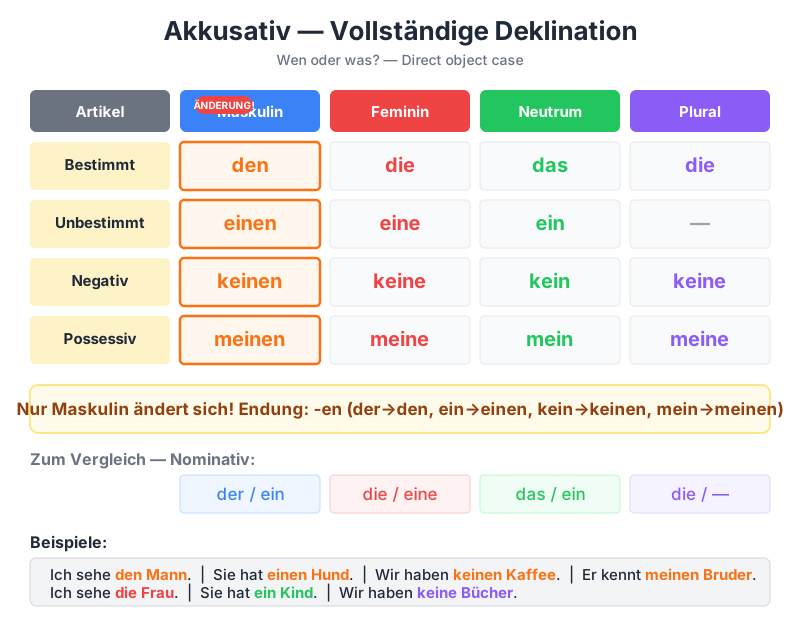
- Nominative instead of accusative: ✗ Ich sehe er → ✓ Ich sehe ihn.
- Confusing mich/mir: mich = accusative, mir = dative.
- Wrong position: ✗ Ich jeden Tag sehe ihn → ✓ Ich sehe ihn jeden Tag.
Common Error Patterns
Used wrong case form of pronoun
Review pronoun declension tables (nom/akk/dat)
Pronoun gender doesn't match the noun it replaces
Check the grammatical gender of the noun before choosing er/sie/es
Mixed up du/Sie or ihr/Sie forms
Review formal vs informal address rules
Verstehst du mich?
Do you understand me?
Ich→mich as direct object.
Ich liebe dich.
I love you.
Du→dich.
Wir kennen ihn seit drei Jahren.
We have known him for three years.
Er→ihn.
Der Lehrer fragt uns jeden Tag.
The teacher asks us every day.
Wir→uns.
Practice in course
Apply this grammar in A2 course exercises
Frequently asked questions
- When is Personalpronomen im Akkusativ used?
- When a personal pronoun is the direct object , it changes form — like English I→me, he→him.
- How is Personalpronomen im Akkusativ formed?
- Only ich, du, er, wir, ihr have distinct accusative forms. Pronoun objects come right after the verb.
- What are common mistakes with Personalpronomen im Akkusativ?
- Nominative instead of accusative: ✗ Ich sehe er → ✓ Ich sehe ihn . Confusing mich/mir: mich = accusative, mir = dative. Wrong position: ✗ Ich jeden Tag sehe ihn → ✓ Ich sehe ihn jeden Tag .