CasosA2
Akkusativ vollständig
Full accusative declension with all article types and personal pronouns
Objetivo de aprendizaje
Can apply accusative endings to all article types
Competencias para el examen:Comprensión lectoraExpresión escritaExpresión oral
Mira estos ejemplos. Puedes identificar el patrón gramatical?
Ich kenne einen guten Arzt.
I know a good doctor.
Kannst du mich morgen anrufen?
Can you call me tomorrow?
Er besucht seinen Bruder jedes Wochenende.
He visits his brother every weekend.
Siehst du die Frau dort?
Do you see the woman there?
Presta atención a las partes resaltadas. Qué tienen en común?
The accusative case marks the direct object — the person or thing directly affected by the action. At A1 you learned that masculine articles change; now we complete the full picture.
Article declension in the accusative:
| Maskulin | Feminin | Neutrum | Plural | |
|---|---|---|---|---|
| bestimmt | den | die | das | die |
| unbestimmt | einen | eine | ein | — |
| Negation | keinen | keine | kein | keine |
| Possessiv | meinen | meine | mein | meine |
Personal pronouns in the accusative: ich→mich, du→dich, er→ihn, sie→sie, es→es, wir→uns, ihr→euch, sie/Sie→sie/Sie. Many common verbs require accusative: sehen, hören, fragen, kennen, besuchen, anrufen, lieben, brauchen, finden, verstehen.
Remember: only masculine singular articles change in the accusative. Feminine, neuter, and plural remain identical to the nominative.
Aplica esta gramática en los ejercicios del curso A2
Ejercicios de práctica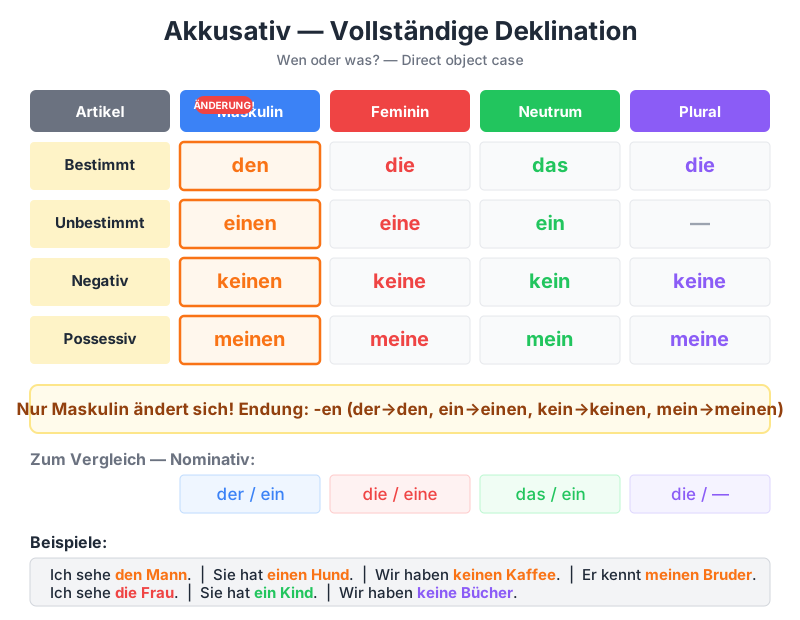
- Forgetting pronoun changes: ✗ Ich sehe er → ✓ Ich sehe ihn.
- Changing feminine/neuter articles: ✗ Ich kaufe den Buch → ✓ Ich kaufe das Buch.
- Missing -en on possessives: ✗ Er besucht sein Bruder → ✓ Er besucht seinen Bruder.
Patrones de errores comunes
Incorrect number word form or usage
Review number patterns and exceptions (eins as standalone vs ein before nouns)
Wrong time expression format
Review formal (14:30 Uhr) vs informal (halb drei) time expressions
Incorrect spelling based on pronunciation rules
Review German spelling conventions: ie=[iː], ei=[aɪ], ß after long vowels, ss after short vowels
Ich kenne einen guten Arzt.
I know a good doctor.
Masculine accusative: ein→einen. Adjective also gets -en.
Kannst du mich morgen anrufen?
Can you call me tomorrow?
Accusative pronoun: ich→mich.
Er besucht seinen Bruder jedes Wochenende.
He visits his brother every weekend.
Possessive accusative masculine: sein→seinen.
Siehst du die Frau dort?
Do you see the woman there?
Feminine accusative: die stays die.
Wir brauchen das Auto nicht.
We don't need the car.
Neuter accusative: das stays das.
Practicar en el curso
Aplica esta gramática en los ejercicios del curso A2