OtrosB2
Wortbildung (Komposita, Präfixe, Suffixe)
German word formation: compounds, prefixes, and suffixes
Objetivo de aprendizaje
Can understand and create compound words and derivations
Competencias para el examen:Comprensión lectoraExpresión escrita
Mira estos ejemplos. Puedes identificar el patrón gramatical?
Der Handschuh liegt auf dem Küchentisch.
The glove is on the kitchen table.
Die Gesundheit ist das Wichtigste.
Health is the most important thing.
Das ist ein Missverständnis.
That is a misunderstanding.
Er hat einen neuen Arbeitsplatz gefunden.
He found a new workplace.
Presta atención a las partes resaltadas. Qué tienen en común?
German is famous for its compound nouns (Komposita). Understanding word formation is essential for reading comprehension at B2+.
Compound nouns: The last element determines gender and meaning category; preceding elements modify it.
| Kompositum | Teile | Gender from |
|---|---|---|
| die Haustür | Haus + Tür | die Tür (fem.) |
| der Apfelkuchen | Apfel + Kuchen | der Kuchen (masc.) |
| das Schlafzimmer | Schlaf + Zimmer | das Zimmer (neut.) |
Linking elements (Fugenzeichen): -(e)s, -(e)n, -e, -er: Arbeitsplatz, Sonnenbrille, Hundefutter, Kindergarten.
Common prefixes: un- (negation: unmöglich), vor- (before: Vorschau), nach- (after: Nachricht), miss- (wrong: Missverständnis).
Common suffixes: -ung (fem., action: Erklärung), -keit/-heit (fem., quality: Freundlichkeit, Gesundheit), -schaft (fem., collective: Gesellschaft), -er (masc., agent: Lehrer).
Aplica esta gramática en los ejercicios del curso B2
Ejercicios de práctica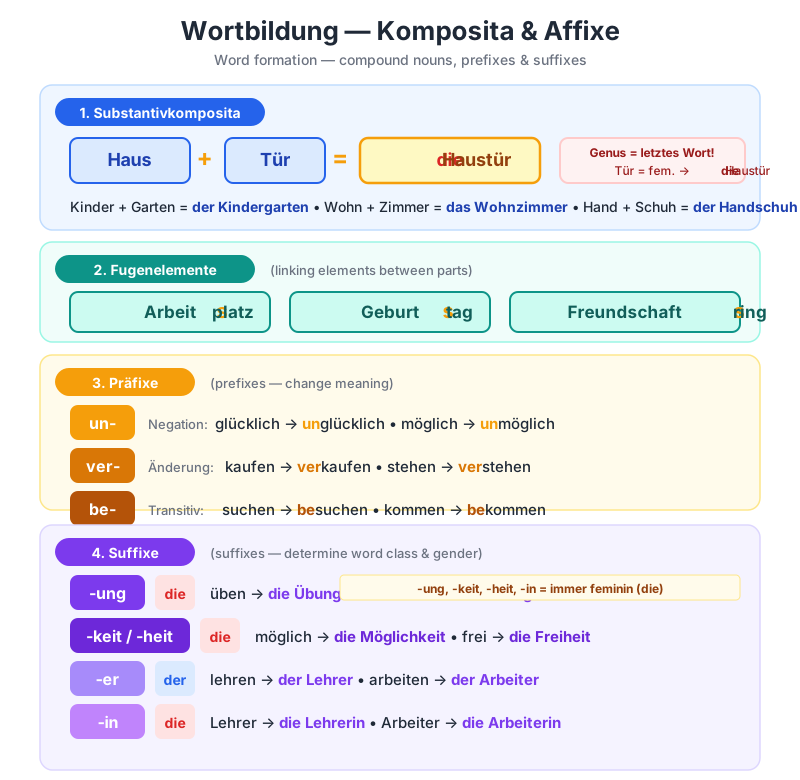
- Wrong gender: Gender comes from the LAST element: die Haustür (die, not das).
- Missing linking element: ✗ Arbeitplatz → ✓ Arbeitsplatz.
- Breaking compounds: German writes compounds as one word: ✗ Apfel Kuchen → ✓ Apfelkuchen.
Patrones de errores comunes
Incorrect number word form or usage
Review number patterns and exceptions (eins as standalone vs ein before nouns)
Wrong time expression format
Review formal (14:30 Uhr) vs informal (halb drei) time expressions
Incorrect spelling based on pronunciation rules
Review German spelling conventions: ie=[iː], ei=[aɪ], ß after long vowels, ss after short vowels
Der Handschuh liegt auf dem Küchentisch.
The glove is on the kitchen table.
Hand+Schuh = glove; Küche+n+Tisch = kitchen table.
Die Gesundheit ist das Wichtigste.
Health is the most important thing.
Gesund + -heit = die Gesundheit (fem.).
Das ist ein Missverständnis.
That is a misunderstanding.
Miss- + Verständnis = misunderstanding.
Er hat einen neuen Arbeitsplatz gefunden.
He found a new workplace.
Arbeit + s (linking) + Platz. Gender from der Platz.
Practicar en el curso
Aplica esta gramática en los ejercicios del curso B2