Personalpronomen
Personal pronouns in nominative case
Can use personal pronouns to refer to people
Look at these examples. Can you spot the grammar pattern?
Ich komme aus Deutschland.
I come from Germany.
Du bist sehr nett.
You are very nice.
Woher kommen Sie?
Where do you come from? (formal)
Pay attention to the highlighted parts. What do they have in common?
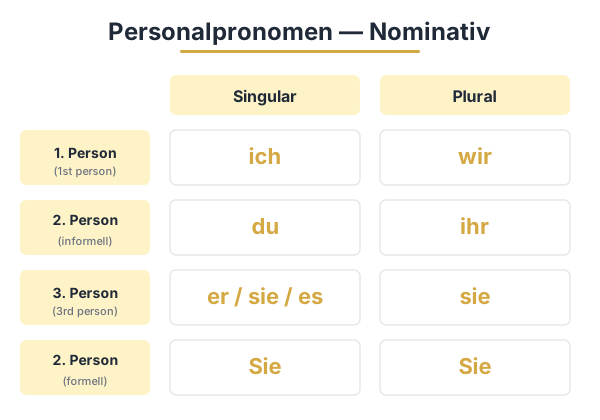
Die Personalpronomen im Nominativ ersetzen Nomen als Subjekt im Satz. Sie zeigen Person und Zahl an.
Übersicht:
| Person | Singular | Plural |
|---|---|---|
| 1. Person | ich | wir |
| 2. Person (informell) | du | ihr |
| 3. Person | er / sie / es | sie |
| 2. Person (formell) | Sie | |
Verwendung: Du verwendet man für Freunde, Familie und Kinder. Ihr ist der Plural von du. Sie (immer groß!) ist die höfliche Form für eine oder mehrere Personen.
3. Person: Er ersetzt maskuline Nomen (der Tisch → er), sie ersetzt feminine (die Lampe → sie), es ersetzt neutrale (das Buch → es). Achtung: sie (klein) = she/they, Sie (groß) = you (formal).
Common Error Patterns
Used wrong case form of pronoun
Review pronoun declension tables (nom/akk/dat)
Pronoun gender doesn't match the noun it replaces
Check the grammatical gender of the noun before choosing er/sie/es
Mixed up du/Sie or ihr/Sie forms
Review formal vs informal address rules
Ich komme aus Deutschland.
I come from Germany.
Ich (I) is always lowercase unless it starts a sentence.
Du bist sehr nett.
You are very nice.
Du is the informal 'you' for friends, family, and children.
Woher kommen Sie?
Where do you come from? (formal)
Sie (formal you) is always capitalized and uses the third-person plural verb form.
Practice in course
Apply this grammar in A1 course exercises