动词A2
Vidové dvojice
Imperfective/perfective verb pairs (dělat/udělat, psát/napsat, kupovat/koupit): process vs completed result and how to pick the right member
学习目标
I can choose between the imperfective and perfective member of common verb pairs to express process or result.
考试技能:CCE A2 · 写作CCE A2 · 口语
观察以下示例,你能发现语法规律吗?
Celé odpoledne jsem vařil guláš, a nakonec jsem ho uvařil perfektně.
I was cooking goulash all afternoon, and in the end I cooked it perfectly.
Každý den kupuju rohlíky, ale dnes jsem koupil i koláče.
Every day I buy rolls, but today I also bought kolaches.
Psala diplomku tři roky. Napsala ji minulý týden.
She was writing her thesis for three years. She finished it last week.
注意高亮部分,它们有什么共同点?
Most Czech verbs come in pairs: an imperfective for the process or the habit, a perfective for one finished act. Once you accept that, two practical questions remain. How do I find a verb's partner? And which of the two does this sentence need?
How the pairs are built
| Imperfective | Perfective | How the pair is made |
|---|---|---|
| psát, vařit, platit | napsat, uvařit, zaplatit | a prefix makes the perfective |
| kupovat, dávat, vstávat | koupit, dát, vstát | the perfective is the basic verb; a suffix makes the imperfective |
| podepisovat, zapisovat | podepsat, zapsat | a prefixed perfective gets its own new imperfective |
| brát, říkat | vzít, říct | two different words |
The third row matters more than it looks. A prefix rarely just "finishes" a verb: it usually adds a meaning. Psát is "to write", but podepsat is "to sign", přepsat "to rewrite" and zapsat "to write down" or "to enrol". These are new verbs, and each gets its own imperfective with a suffix: podepisovat, přepisovat, zapisovat. Only napsat is the plain partner of psát. That is why a good dictionary marks every verb nedok. (imperfective) or dok. (perfective), and why pairs are best learnt together, like the gender of a noun. A few common verbs, such as být, mít and vědět, have no partner at all.
Which one? Signals in the sentence
| Pulls towards the imperfective | Pulls towards the perfective |
|---|---|
| how long: celý den, dvě hodiny, dlouho | how fast it was done: za dvě hodiny, už, konečně |
| how often: každý den, často, obvykle | a definite amount: celou knihu, dvě piva |
| after začít and přestat: Začal jsem se učit česky. | a result you can point to: Opravil jsem kolo, už jezdí. |
| a negative command: Nekupuj chleba, máme. | a positive request for one act: Kup chleba, prosím. |
Here English helps more than you might expect. "For two hours" and "in two hours" usually split along the aspect line: Psal jsem to dvě hodiny (I worked on it for two hours) against Napsal jsem to za dvě hodiny (I got it done in two hours). The exception is "in two hours" meaning "two hours from now": za dvě hodiny then takes either aspect (Za dvě hodiny budu vařit / uvařím). Questions split the same way: Co jsi dělal o víkendu? asks about your activities, Udělal jsi ten úkol? asks whether the job is done.
The one place English misleads is the simple past. "She wrote her thesis" can be either: Psala diplomku tři roky (the long work), Napsala ji za jedno léto (the finished result). Ask yourself whether you are looking at the activity or at the outcome, not whether English uses "-ing".
在 A2 课程练习中应用此语法
练习题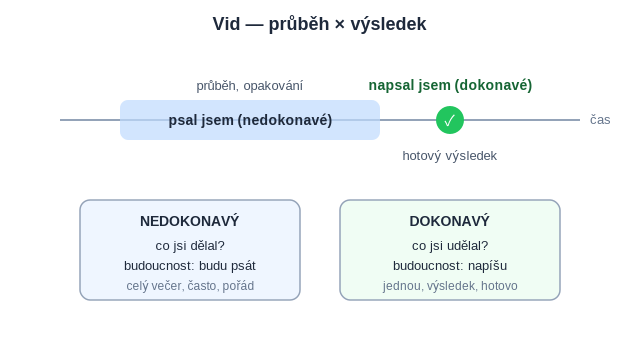
- EN/DE speakers use one verb for both meanings: choose by question — co jsi dělal? (imperf.) vs co jsi udělal? (perf.)
- Wrong prefix from RU/UK transfer: *zdělat → udělat
- Perfective with 'celý večer': *Napsal jsem dopis celý večer → Psal jsem (duration = imperfective)
Celé odpoledne jsem vařil guláš, a nakonec jsem ho uvařil perfektně.
I was cooking goulash all afternoon, and in the end I cooked it perfectly.
vařil = process all afternoon; uvařil = the completed result.
Každý den kupuju rohlíky, ale dnes jsem koupil i koláče.
Every day I buy rolls, but today I also bought kolaches.
kupuju = habitual imperfective; koupil = one completed purchase.
Psala diplomku tři roky. Napsala ji minulý týden.
She was writing her thesis for three years. She finished it last week.
Three years of process (psala) vs the completion moment (napsala).
这个主题的检测还在准备中
问问索菲
在课程中练习
在 A2 课程练习中应用此语法