代词A2
Osobní zájmena – krátké a dlouhé tvary
Short unstressed vs long stressed pronoun forms (mě/mne, ho/jeho, mu/jemu) and the n- forms after prepositions (něj, něho, němu)
学习目标
I can choose between short, long and n- pronoun forms according to position, emphasis and prepositions.
考试技能:CCE A2 · 听力CCE A2 · 口语
观察以下示例,你能发现语法规律吗?
Dám ti to zítra, ale jemu nic nedám.
I'll give it to you tomorrow, but I won't give him anything.
Čekáme na něj před kinem Lucerna.
We are waiting for him in front of the Lucerna cinema.
Znáš Karla? Potkal jsem ho dnes na Andělu.
Do you know Karel? I met him today at Anděl.
注意高亮部分,它们有什么共同点?
You have met the short and long pronouns one case at a time: mi and mně, tě and tebe, ho and jeho. Put side by side, they follow one rule, and it is a rule about stress and position, not meaning. English stresses a pronoun with the voice ("give it to HIM"); Czech picks a different word.
| Meaning | Short (unstressed) | Long (stressed) | After a preposition |
|---|---|---|---|
| me (gen., acc.) | mě | mě, formal mne | u mě, pro mě |
| to me (dat.) | mi | mně | ke mně |
| you (gen., acc.) | tě | tebe | u tebe, pro tebe |
| to you (dat.) | ti | tobě | k tobě |
| him (gen., acc.) | ho | jeho | u něj / u něho, pro něj |
| to him (dat.) | mu | jemu | k němu |
| oneself (acc. / dat.) | se / si | sebe / sobě | pro sebe, k sobě |
The other persons have a single form (ji, jí, nás, vám, je, jim), but the third person still adds n- after a preposition: pro ni, k ní, s nimi, bez nich. Ho also stands for neuter "it", and in formal writing you will see jej in its place.
Short forms: unstressed, in second place
The short forms lean on the word before them. They cannot carry stress, so they cannot open a sentence or stand alone; they take the second slot, after the first word or phrase: Znáš ho? Babička mu peče buchty. When several meet, the order is fixed: first jsem, jsi, bych, bys, then se or si, then the dative, then the accusative. Včera jsem si ho koupil. Půjčil bys mi ho? Where English puts "it to me" at the end, Czech packs the whole cluster in near the front.
Long forms: when the pronoun is the news
Use the long form for contrast, often moved to the front: Tobě to dám, jemu ne. Use it when the pronoun stands alone: Koho hledáš? - Tebe. Komu to patří? - Mně. Without a reason it sounds pointed: Vidím jeho means "it's him I can see", not just "I can see him".
After a preposition
Prepositions take the long forms: k tobě, never *k ti; k němu, never *k mu. In the third person the long form swaps j- for n-: Čekáme na něj před Lucernou. Bez ní na chalupu nepojedu. Něj and něho are both standard; něj is the everyday one.
The his/him trap
The possessive jeho ("his") looks like the long pronoun but never takes n- and never changes: bez jeho pomoci (without his help), but bez něj (without him). Jejich ("their") is the same: u jejich babičky, but u nich. Její ("her") also keeps its j- (u její babičky, but u ní), but unlike the other two it declines, like jarní: bez jejího bratra, k jejímu domu, v jejím autě. A quick test: if a noun follows, it is the possessive and takes no n-; if the word stands for the person, use the n- form.
在 A2 课程练习中应用此语法
练习题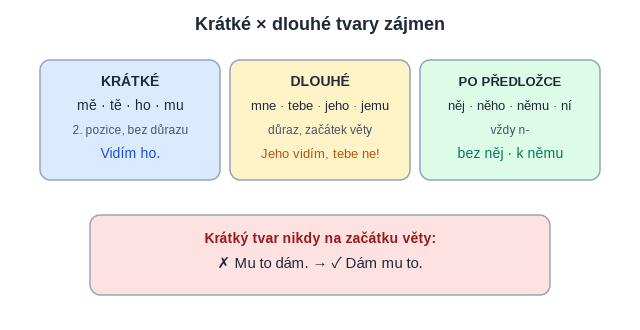
- Short form at sentence start: *Mu to dám → Dám mu to
- Missing n- after prepositions: *bez jeho ("without him") → bez něj; bez jeho pomoci ("without his help") is correct
- Long form without emphasis: Vidím jeho (only with contrast) vs neutral Vidím ho
Dám ti to zítra, ale jemu nic nedám.
I'll give it to you tomorrow, but I won't give him anything.
ti = short neutral, jemu = long contrastive at the front.
Čekáme na něj před kinem Lucerna.
We are waiting for him in front of the Lucerna cinema.
na + 3rd person pronoun takes the n-form: něj.
Znáš Karla? Potkal jsem ho dnes na Andělu.
Do you know Karel? I met him today at Anděl.
ho sits in second position after 'jsem' — the clitic cluster.
这个主题的检测还在准备中
问问索菲
在课程中练习
在 A2 课程练习中应用此语法