格A1
Dativ bei Körperteilen
Mir tut der Kopf weh — dative with body parts
学习目标
Can describe pain and body issues using dative
考试技能:听力口语
观察以下示例,你能发现语法规律吗?
Mir tut der Rücken weh.
My back hurts.
Tut dir der Bauch weh?
Does your stomach hurt?
Ihm tun die Augen weh.
His eyes hurt.
注意高亮部分,它们有什么共同点?
English says "my head hurts", with a possessive. The everyday German version names the person in the dative and uses the definite article for the body part: Mir tut der Kopf weh - literally "to me the head does hurt".
Pattern: dative pronoun + tut / tun ... weh (from wehtun, "to hurt").
| Person | Dative | Example | English |
|---|---|---|---|
| ich | mir | Mir tut der Kopf weh. | My head hurts. |
| du | dir | Tut dir der Rücken weh? | Does your back hurt? |
| er | ihm | Ihm tut das Bein weh. | His leg hurts. |
| sie | ihr | Ihr tut der Bauch weh. | Her stomach hurts. |
| wir | uns | Uns tun die Füße weh. | Our feet hurt. |
| Sie | Ihnen | Tut Ihnen etwas weh? | Does anything hurt? (formal) |
tut or tun?
The verb agrees with the body part, not with the person, because the body part is the subject. One part: Mir tut der Hals weh. Several: Mir tun die Augen weh. English speakers often make the verb agree with "me", which is the wrong word to look at.
Why the dative?
The dative pronoun already shows whose head it is, so the possessive would say the same thing twice. German does this with the body in general: Ich wasche mir die Hände (I wash my hands), Er hat sich das Bein gebrochen (he broke his leg). Mein Kopf tut weh is understood and you will hear it, but Mir tut der Kopf weh is the form Germans reach for first.
At the doctor's
The Hausarzt will ask Was fehlt Ihnen? or Wo tut es weh? You can answer with the pattern above or with a compound noun: Ich habe Kopfschmerzen / Halsschmerzen / Bauchschmerzen. After a day's hiking in the Alps, the one you are likely to need is Mir tun die Füße weh.
Watch the small word ihr: here it means "to her" (Ihr tut der Bauch weh), not "you all" and not "her" as a possessive.
在 A1 课程练习中应用此语法
练习题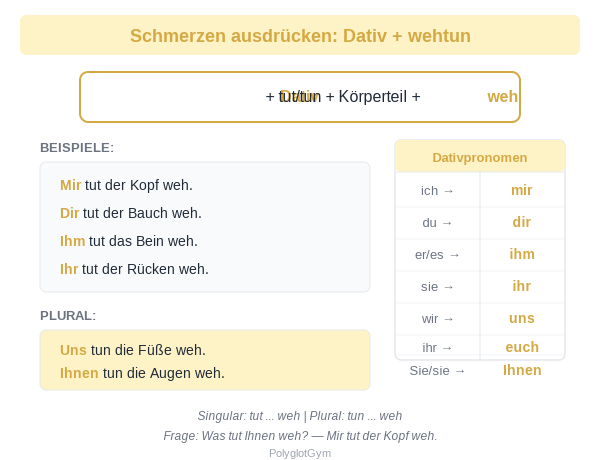
Learners say Mein Kopf tut weh (possessive) instead of Mir tut der Kopf weh (dative). German uses the dative pronoun, not the possessive.
🇬🇧 English speakers: English speakers use possessives: 'Mein Kopf tut weh' instead of 'Mir tut der Kopf weh' — English always uses 'my' with body parts.
Mir tut der Rücken weh.
My back hurts.
Mir (dative) + tut + body part + weh. Not: Mein Rücken tut weh.
Tut dir der Bauch weh?
Does your stomach hurt?
Dir (dative for du) + tut + der Bauch + weh.
Ihm tun die Augen weh.
His eyes hurt.
Plural body part: tun (not tut). Ihm = dative for er.
这个主题的检测还在准备中
问问索菲
在课程中练习
在 A1 课程练习中应用此语法