其他A1
Zahlen 0-10
Numbers from zero to ten
学习目标
Can understand and use numbers in everyday situations
考试技能:听力口语
观察以下示例,你能发现语法规律吗?
Meine Telefonnummer ist null-drei-eins-fünf.
My phone number is 0-3-1-5.
Ich habe zwei Kinder.
I have two children.
Das kostet sieben Euro.
That costs seven euros.
注意高亮部分,它们有什么共同点?
The numbers from zero to ten are the building blocks of every German number, and several of them look like their English cousins: drei and three, acht and eight, neun and nine.
| Number | German | Number | German |
|---|---|---|---|
| 0 | null | 6 | sechs |
| 1 | eins | 7 | sieben |
| 2 | zwei | 8 | acht |
| 3 | drei | 9 | neun |
| 4 | vier | 10 | zehn |
| 5 | fünf |
Pronunciation traps
Zwei and zehn start with "ts", not "z": "tsvy", "tsayn". Vier starts with an f-sound, like "fear". Sechs sounds like "zecks", and neun rhymes with "coin" with an n in front. In fünf, round your lips for the ü; "funf" is the English-speaker version Germans notice at once.
zwei or zwo?
On the phone, at a train station or in the army you will hear zwo instead of zwei. It exists because zwei and drei are easy to confuse on a bad line. Deutsche Bahn announcements say Gleis zwo (platform two), and a Berliner might read out a phone number as null-drei-null, zwo-fünf-sieben.
eins, ein, eine
When you count or give a number on its own, you say eins: eins, zwei, drei; Wie viele Brötchen? - Eins. Referring back to a noun, the number follows the noun's gender: Wie viele Brezeln? - Eine. Before a noun, "one" turns into the article ein or eine, depending on the noun's gender: ein Brötchen, eine Brezel. English uses "a" and "one" for two different jobs; German uses one word for both, so Ich habe ein Kind can mean "a child" or "one child". Stress ein to make it "one".
在 A1 课程练习中应用此语法
练习题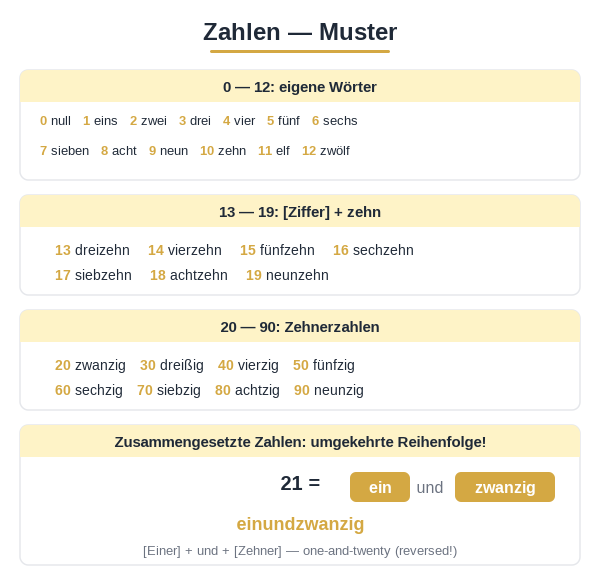
Learners mix up vier (4) and für (for), or drei (3) and zwei (2) because they rhyme.
🇬🇧 English speakers: English speakers confuse zwei/drei due to rhyming, and may pronounce sechs like English 'sex' instead of [zɛks].
Meine Telefonnummer ist null-drei-eins-fünf.
My phone number is 0-3-1-5.
Phone numbers are read digit by digit in German.
Ich habe zwei Kinder.
I have two children.
Zwei (two) is used as a normal number before nouns.
Das kostet sieben Euro.
That costs seven euros.
Euro stays singular in German even after numbers: sieben Euro, not Euros.
这个主题的检测还在准备中
问问索菲
在课程中练习
在 A1 课程练习中应用此语法