代词A1
Personalpronomen
Personal pronouns in nominative case
学习目标
Can use personal pronouns to refer to people
考试技能:写作口语
观察以下示例,你能发现语法规律吗?
Ich komme aus Deutschland.
I come from Germany.
Du bist sehr nett.
You are very nice.
Woher kommen Sie?
Where do you come from? (formal)
注意高亮部分,它们有什么共同点?
A personal pronoun stands in for a person or thing; this page covers the subject forms. English gets by with one "you"; German has three, and it also uses "he" and "she" for things.
| Person | Singular | Plural |
|---|---|---|
| 1st | ich - I | wir - we |
| 2nd, informal | du - you (one friend) | ihr - you (several friends) |
| 3rd | er / sie / es - he / she / it | sie - they |
| 2nd, formal | Sie - you (one person or several) | |
Note that ich is written with a small letter unless it starts the sentence. English capitalises "I"; German capitalises the formal Sie instead.
du, ihr or Sie?
Du is for family, friends, children and animals, and among students and young colleagues. Ihr is simply the plural of du: what you say to a group of friends, like "you guys" or "y'all". Sie is the polite form for adults you do not know well, shop staff, officials and your doctor, whether you address one person or a whole table. In a Munich bakery you ask Haben Sie Brezeln?; to your flatmate you say Hast du Hunger? If unsure, start with Sie and wait for the other person to offer du ("Wollen wir uns duzen?").
Three words that look like sie
Small sie can mean "she" or "they", and capital Sie means "you". The verb ending usually tells them apart: sie kommt (she comes), sie kommen (they come), Sie kommen (you come). At the start of a sentence, where both sie and Sie are written with a capital, context has to decide: Sie kommen aus Wien? could ask "Are they from Vienna?" or "Are you from Vienna?"
he and she for things
In English a table is "it". In German the pronoun follows the noun's grammatical gender: der Tisch → er, die Lampe → sie, das Buch → es. So Wo ist der Löffel? - Er liegt auf dem Tisch. (Where is the spoon? - It is on the table.) Calling the spoon es is a mistake English speakers make often, because "it" feels right.
在 A1 课程练习中应用此语法
练习题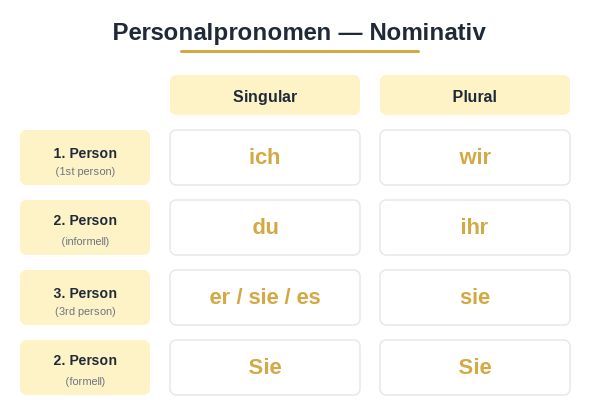
Beginners confuse sie (she), sie (they), and Sie (you-formal). Context and verb conjugation help distinguish them.
🇬🇧 English speakers: English speakers forget that 'you' has three forms (du/ihr/Sie) and default to a single form for all registers.
Ich komme aus Deutschland.
I come from Germany.
Ich (I) is always lowercase unless it starts a sentence.
Du bist sehr nett.
You are very nice.
Du is the informal 'you' for friends, family, and children.
Woher kommen Sie?
Where do you come from? (formal)
Sie (formal you) is always capitalized and uses the third-person plural verb form.
这个主题的检测还在准备中
问问索菲
在课程中练习
在 A1 课程练习中应用此语法