格A2
Падежи во множественном числе
The plural case overview: -ам/-ами/-ах are gender-blind, the genitive plural is the only hard spot
学习目标
I can decline nouns in all plural cases using the gender-blind endings.
考试技能:ТРКИ ТБУ
观察以下示例,你能发现语法规律吗?
Бабушка раздала внукам пирожки с капустой и яблоками.
Grandma handed out pirozhki with cabbage and apples to her grandchildren.
Мы долго говорили о городах, в которых хотели бы жить.
We talked for a long time about the cities we would like to live in.
注意高亮部分,它们有什么共同点?
Good news after the singular: in the plural, the three genders mostly stop mattering. Three of the six cases end the same way whether the noun is masculine, feminine or neuter, and one more copies another case.
| Case | Ending | Examples |
|---|---|---|
| Dative | -ам / -ям | домам, книгам, морям |
| Instrumental | -ами / -ями | домами, книгами, морями |
| Prepositional | -ах / -ях | о домах, о книгах, о морях |
| Accusative | = nominative (things) / = genitive (people, animals) | вижу дома vs вижу друзей |
| Genitive | -ов / -ей / no ending | домов, ночей, книг |
The easy three. Dative, instrumental and prepositional plurals are built on one pattern: -ам, -ами, -ах after a hard consonant, -ям, -ями, -ях after a soft one. A memory hook: the endings -ам, -ами, -ах are shared by all three genders. So мы гуляли по улицам, с друзьями, в городах России. A handful of nouns have a different instrumental, and they are common: людьми, детьми, дочерьми, and дверьми beside the newer дверями.
The accusative depends on life, not gender. For things, the accusative plural looks like the nominative: Я люблю эти дома. For people and animals, it looks like the genitive: Я вижу друзей, Мы встретили сестёр, Он кормит кошек. In the plural this applies to all genders, feminine included. English speakers tend to use the nominative everywhere, so *вижу друзья is the mistake to listen for.
The hard one is the genitive plural: -ов (столов), -ей (ночей, друзей) or no ending at all (книг, мест). It has a topic of its own; learn it with numbers, because пять and above need it: пять книг, десять рублей.
在 A2 课程练习中应用此语法
练习题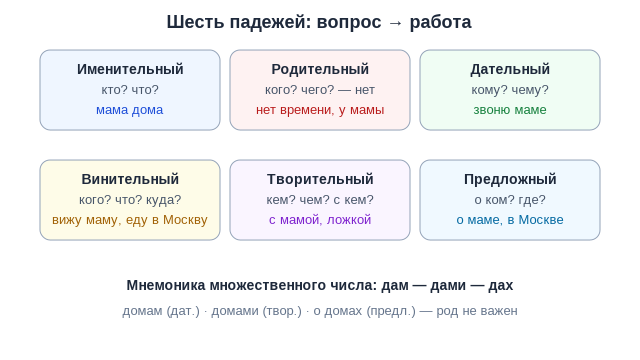
- Gender-specific endings invented: plural dative is always -ам/-ям
- Animate accusative plural: вижу *друзья → друзей
Бабушка раздала внукам пирожки с капустой и яблоками.
Grandma handed out pirozhki with cabbage and apples to her grandchildren.
внукам (dat.) + яблоками (instr.): plural endings in action.
Мы долго говорили о городах, в которых хотели бы жить.
We talked for a long time about the cities we would like to live in.
о городах: prepositional plural -ах.
这个主题的检测还在准备中
问问索菲
在课程中练习
在 A2 课程练习中应用此语法