VerbsA1
Imperativ (Sie-Form)
Formal commands: Gehen Sie! Nehmen Sie!
Learning Goal
Can give formal instructions and commands
Exam Skills:WritingSpeaking
Look at these examples. Can you spot the grammar pattern?
Nehmen Sie bitte Platz!
Please take a seat!
Gehen Sie geradeaus und dann links.
Go straight ahead and then left.
Rufen Sie mich morgen an!
Call me tomorrow!
Pay attention to the highlighted parts. What do they have in common?
Der formelle Imperativ (Sie-Form) wird für höfliche Aufforderungen und Anweisungen verwendet.
Bildung: Infinitiv + Sie:
| Infinitiv | Imperativ | Bedeutung |
|---|---|---|
| kommen | Kommen Sie! | Come! (formal) |
| nehmen | Nehmen Sie Platz! | Take a seat! |
| gehen | Gehen Sie geradeaus! | Go straight! |
| warten | Warten Sie bitte! | Please wait! |
Wortstellung: Verb zuerst, dann Sie, dann der Rest. Es sieht aus wie eine Ja/Nein-Frage, hat aber ein Ausrufezeichen.
Trennbare Verben: Machen Sie bitte das Fenster auf! Rufen Sie mich morgen an!
Tipp: Bitte macht den Imperativ höflicher: Sprechen Sie bitte langsamer!
Apply this grammar in A1 course exercises
Practice Exercises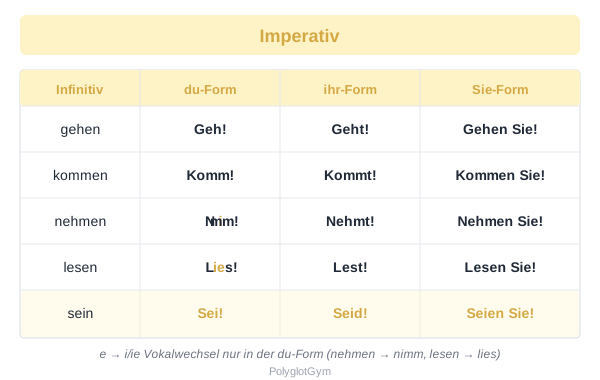
Learners forget to include Sie: Kommen! instead of Kommen Sie! The Sie is mandatory in formal commands.
🇬🇧 English speakers: English speakers may drop 'Sie' since English imperatives have no pronoun: 'Kommen!' instead of 'Kommen Sie!' — the pronoun is mandatory.
Common Error Patterns
Incorrect verb ending for the subject
Review verb conjugation tables and practice matching endings to pronouns
Forgot stem vowel change in irregular verbs
Practice stem-changing verbs (e→i, e→ie, a→ä) with flashcards
Verb placed in wrong position
Remember: V2 in main clauses, verb-final in subordinate clauses
Nehmen Sie bitte Platz!
Please take a seat!
Formal command: verb + Sie. Bitte makes it polite.
Gehen Sie geradeaus und dann links.
Go straight ahead and then left.
Giving directions formally: Gehen Sie + direction.
Rufen Sie mich morgen an!
Call me tomorrow!
Separable verb anrufen: an goes to the end.
Practice in course
Apply this grammar in A1 course exercises
Frequently asked questions
- When is Imperativ (Sie-Form) used?
- Der formelle Imperativ (Sie-Form) wird für höfliche Aufforderungen und Anweisungen verwendet.
- How is Imperativ (Sie-Form) formed?
- Wortstellung: Verb zuerst, dann Sie , dann der Rest. Es sieht aus wie eine Ja/Nein-Frage, hat aber ein Ausrufezeichen. Trennbare Verben: Machen Sie bitte das Fenster auf ! Rufen Sie mich morgen an ! Tipp: Bitte macht den Imperativ höflicher: Sprechen Sie bitte langsamer!
- What are common mistakes with Imperativ (Sie-Form)?
- Learners forget to include Sie: Kommen! instead of Kommen Sie! The Sie is mandatory in formal commands. 🇬🇧 English speakers: English speakers may drop 'Sie' since English imperatives have no pronoun: 'Kommen!' instead of 'Kommen Sie!' — the pronoun is mandatory. 🇷🇺 Russian speakers: Russian speakers may use infinitive-based commands (as in Russian impersonal orders) instead of the conjugated verb + Sie form. 🇨🇿 Czech speakers: Czech speakers may use Czech-style imperative endings instead of the German infinitive + Sie pattern, since Czech formal commands work differently.