ArticlesA1
Possessivartikel
Possessive articles mein/dein/sein/ihr
Learning Goal
Can express possession using possessive articles
Exam Skills:ReadingWritingSpeaking
Look at these examples. Can you spot the grammar pattern?
Das ist mein Buch.
That is my book.
Wo ist deine Tasche?
Where is your bag?
Seine Kinder sind noch klein.
His children are still small.
Pay attention to the highlighted parts. What do they have in common?
Possessivartikel zeigen Besitz an und stehen vor dem Nomen wie ein Artikel.
| Person | Possessiv | Person | Possessiv |
|---|---|---|---|
| ich | mein | wir | unser |
| du | dein | ihr | euer |
| er/es | sein | sie (Pl.) | ihr |
| sie | ihr | Sie (formal) | Ihr |
Endungen wie ein/kein: Possessivartikel deklinieren wie ein:
| Maskulin | Feminin | Neutrum | Plural | |
|---|---|---|---|---|
| Nominativ | mein | meine | mein | meine |
| Akkusativ | meinen | meine | mein | meine |
Beispiele: Das ist mein Bruder. Ich sehe deinen Hund. Unsere Kinder spielen.
Apply this grammar in A1 course exercises
Practice Exercises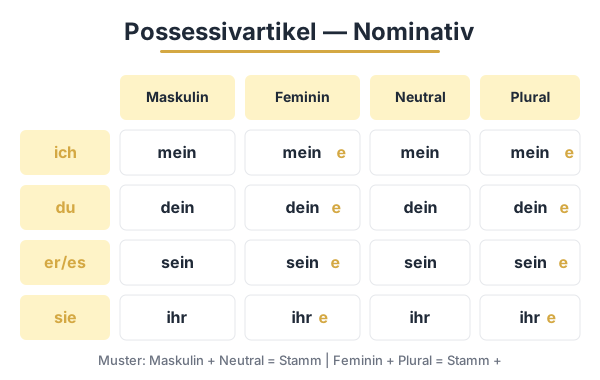
Learners mix up sein (his) and ihr (her), or forget to decline: mein Schwester instead of meine Schwester.
🇬🇧 English speakers: English speakers forget to decline possessives: 'mein Schwester' instead of 'meine Schwester' — English 'my' never changes form.
Common Error Patterns
Wrong article gender (der/die/das)
Learn nouns with articles. Use patterns: -ung/-heit/-keit are feminine, -chen/-lein are neuter
Article not declined for correct case
Identify sentence role (subject=nom, direct object=akk, indirect object=dat) then apply article
Used definite when indefinite needed or vice versa
First mention = ein/eine, known/specific = der/die/das
Das ist mein Buch.
That is my book.
Buch is neuter (das) — mein has no ending in nominative neuter.
Wo ist deine Tasche?
Where is your bag?
Tasche is feminine (die) — dein gets -e ending: deine.
Seine Kinder sind noch klein.
His children are still small.
Plural uses -e ending: seine Kinder (like die → keine → seine).
Practice in course
Apply this grammar in A1 course exercises
Frequently asked questions
- When is Possessivartikel used?
- Possessivartikel zeigen Besitz an und stehen vor dem Nomen wie ein Artikel.
- How is Possessivartikel formed?
- Endungen wie ein/kein: Possessivartikel deklinieren wie ein : Beispiele: Das ist mein Bruder. Ich sehe deinen Hund. Unsere Kinder spielen.
- What are common mistakes with Possessivartikel?
- Learners mix up sein (his) and ihr (her), or forget to decline: mein Schwester instead of meine Schwester. 🇬🇧 English speakers: English speakers forget to decline possessives: 'mein Schwester' instead of 'meine Schwester' — English 'my' never changes form. 🇷🇺 Russian speakers: Russian speakers may use the wrong gender form since Russian possessive gender must match the owner in some cases, not the noun as in German. 🇨🇿 Czech speakers: Czech speakers handle possessive declension well but may apply Czech gender patterns, leading to wrong endings when DE/CZ genders differ.