VerbsB1
Präteritum regelmäßige Verben
Simple past tense formation for regular (weak) verbs
Learning Goal
Can narrate past events using regular simple past forms
Exam Skills:ReadingWriting
Look at these examples. Can you spot the grammar pattern?
Sie machte die Tür auf.
She opened the door.
Wir reisten nach Spanien.
We traveled to Spain.
Er arbeitete den ganzen Tag.
He worked all day.
Die Kinder spielten im Garten.
The children played in the garden.
Pay attention to the highlighted parts. What do they have in common?
At A2 you learned Präteritum of sein, haben, and modals. Now we extend to all regular verbs — essential for written narratives.
Formation: stem + -te + personal ending.
| machen | arbeiten | reisen | |
|---|---|---|---|
| ich | machte | arbeitete | reiste |
| du | machtest | arbeitetest | reistest |
| er/sie/es | machte | arbeitete | reiste |
| wir | machten | arbeiteten | reisten |
| ihr | machtet | arbeitetet | reistet |
| sie/Sie | machten | arbeiteten | reisten |
Stems ending in -t, -d, -chn, -ffn insert extra -e-: arbeitete, öffnete.
Usage: Written texts prefer Präteritum. Spoken German prefers Perfekt except for sein/haben/modals.
Apply this grammar in B1 course exercises
Practice Exercises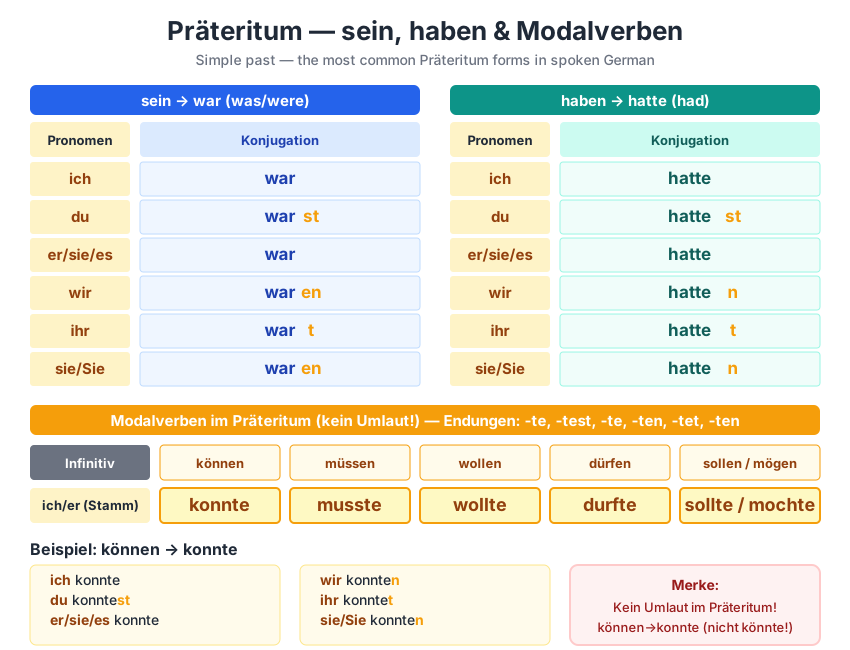
- Forgetting -te: Always include the -te marker for regular verbs.
- Missing buffer -e-: Stems ending in -t need it: arbeitete.
- Using Präteritum in speech: Sounds literary. Use Perfekt in conversation.
Common Error Patterns
Incorrect verb ending for the subject
Review verb conjugation tables and practice matching endings to pronouns
Forgot stem vowel change in irregular verbs
Practice stem-changing verbs (e→i, e→ie, a→ä) with flashcards
Verb placed in wrong position
Remember: V2 in main clauses, verb-final in subordinate clauses
Sie machte die Tür auf.
She opened the door.
Machte = Präteritum of machen.
Wir reisten nach Spanien.
We traveled to Spain.
Reisten = Präteritum of reisen.
Er arbeitete den ganzen Tag.
He worked all day.
Arbeitete: stem -t, extra -e- inserted.
Die Kinder spielten im Garten.
The children played in the garden.
Spielten = standard regular Präteritum.
Practice in course
Apply this grammar in B1 course exercises
Frequently asked questions
- When is Präteritum regelmäßige Verben used?
- At A2 you learned Präteritum of sein, haben, and modals. Now we extend to all regular verbs — essential for written narratives .
- How is Präteritum regelmäßige Verben formed?
- Stems ending in -t, -d, -chn, -ffn insert extra -e- : arbeit e te, öffn e te . Usage: Written texts prefer Präteritum. Spoken German prefers Perfekt except for sein/haben/modals.
- What are common mistakes with Präteritum regelmäßige Verben?
- Forgetting -te: Always include the -te marker for regular verbs. Missing buffer -e-: Stems ending in -t need it: arbeit e te. Using Präteritum in speech: Sounds literary. Use Perfekt in conversation.