Sentence StructureA2
Nebensätze: dass, wenn, ob
Subordinate clauses with dass, wenn, and ob
Learning Goal
Can form complex sentences with dass, wenn, and ob
Exam Skills:ReadingWritingSpeaking
Look at these examples. Can you spot the grammar pattern?
Ich hoffe, dass du bald kommst.
I hope that you come soon.
Wenn ich Zeit habe, gehe ich ins Kino.
If I have time, I go to the cinema.
Weißt du, ob der Laden offen ist?
Do you know whether the store is open?
Er sagt, dass er morgen nicht kommen kann.
He says he can't come tomorrow.
Pay attention to the highlighted parts. What do they have in common?
Subordinating conjunctions send the conjugated verb to the end. At A1 you learned weil; now three more:
| Konjunktion | Bedeutung | Verwendung |
|---|---|---|
| dass | that | Reporting thoughts, facts |
| wenn | if / when(ever) | Conditions, repeated events |
| ob | whether | Indirect yes/no questions |
Dass: Ich glaube, dass er Recht hat. Wenn: Wenn es regnet, bleibe ich zu Hause. Ob: Ich weiß nicht, ob er kommt.
Subordinate clause first: Main clause verb right after comma: Wenn es regnet, bleibe ich zu Hause.
Apply this grammar in A2 course exercises
Practice Exercises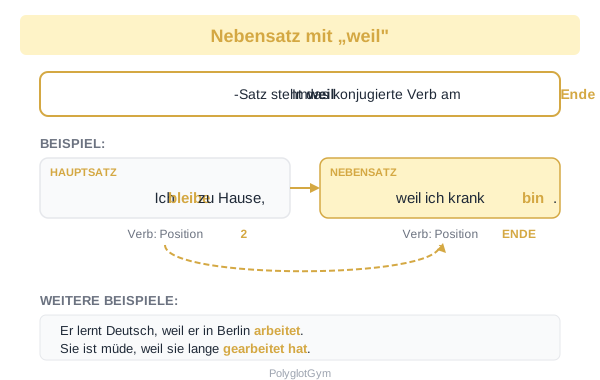
- Verb not at end: ✗ dass er hat Recht → ✓ dass er Recht hat.
- Ob for certainties: ✗ Ich weiß, ob er kommt → ✓ Ich weiß, dass er kommt.
- Wrong main clause order: ✗ Wenn es regnet, ich bleibe → ✓ Wenn es regnet, bleibe ich.
Common Error Patterns
Verb not in second position in main clause
Count positions: element 1 + VERB + rest. The verb is always second.
Wrong word order in subordinate clause
In subordinate clauses (weil, dass, wenn...) the verb goes to the END
Wrong connector or connector type used
Review: coordinating (und, aber, oder) vs subordinating (weil, dass, wenn) conjunctions
Ich hoffe, dass du bald kommst.
I hope that you come soon.
Dass-clause: verb kommst at the end.
Wenn ich Zeit habe, gehe ich ins Kino.
If I have time, I go to the cinema.
Wenn-clause first; gehe after comma.
Weißt du, ob der Laden offen ist?
Do you know whether the store is open?
Ob for indirect yes/no question.
Er sagt, dass er morgen nicht kommen kann.
He says he can't come tomorrow.
Modal in dass-clause: kann goes to the end.
Practice in course
Apply this grammar in A2 course exercises
Frequently asked questions
- When is Nebensätze: dass, wenn, ob used?
- Subordinating conjunctions send the conjugated verb to the end . At A1 you learned weil ; now three more:
- How is Nebensätze: dass, wenn, ob formed?
- Dass : Ich glaube, dass er Recht hat . Wenn : Wenn es regnet , bleibe ich zu Hause . Ob : Ich weiß nicht, ob er kommt . Subordinate clause first: Main clause verb right after comma: Wenn es regnet, bleibe ich zu Hause .
- What are common mistakes with Nebensätze: dass, wenn, ob?
- Verb not at end: ✗ dass er hat Recht → ✓ dass er Recht hat . Ob for certainties: ✗ Ich weiß, ob er kommt → ✓ Ich weiß, dass er kommt . Wrong main clause order: ✗ Wenn es regnet, ich bleibe → ✓ Wenn es regnet, bleibe ich .