PrepositionsA1
Wechselpräpositionen
Two-way prepositions: accusative vs. dative
Learning Goal
Can distinguish location and direction with two-way prepositions
Exam Skills:ReadingWritingSpeaking
Look at these examples. Can you spot the grammar pattern?
Ich gehe in den Supermarkt.
I am going to the supermarket.
Das Buch liegt auf dem Tisch.
The book is lying on the table.
Sie hängt das Bild an die Wand.
She is hanging the picture on the wall.
Pay attention to the highlighted parts. What do they have in common?
Neun Präpositionen — die Wechselpräpositionen — können sowohl Akkusativ als auch Dativ verlangen.
| Präposition | Bedeutung | Präposition | Bedeutung |
|---|---|---|---|
| in | in, into | vor | in front of |
| an | at, on (vertical) | hinter | behind |
| auf | on (horizontal) | neben | next to |
| über | over, above | zwischen | between |
| unter | under |
Regel: Wohin? (Bewegung/Richtung) → Akkusativ: Ich gehe in den Park. Wo? (Ort/Position) → Dativ: Ich bin im (= in dem) Park.
Kurzformen: in dem = im, in das = ins, an dem = am, an das = ans.
Apply this grammar in A1 course exercises
Practice Exercises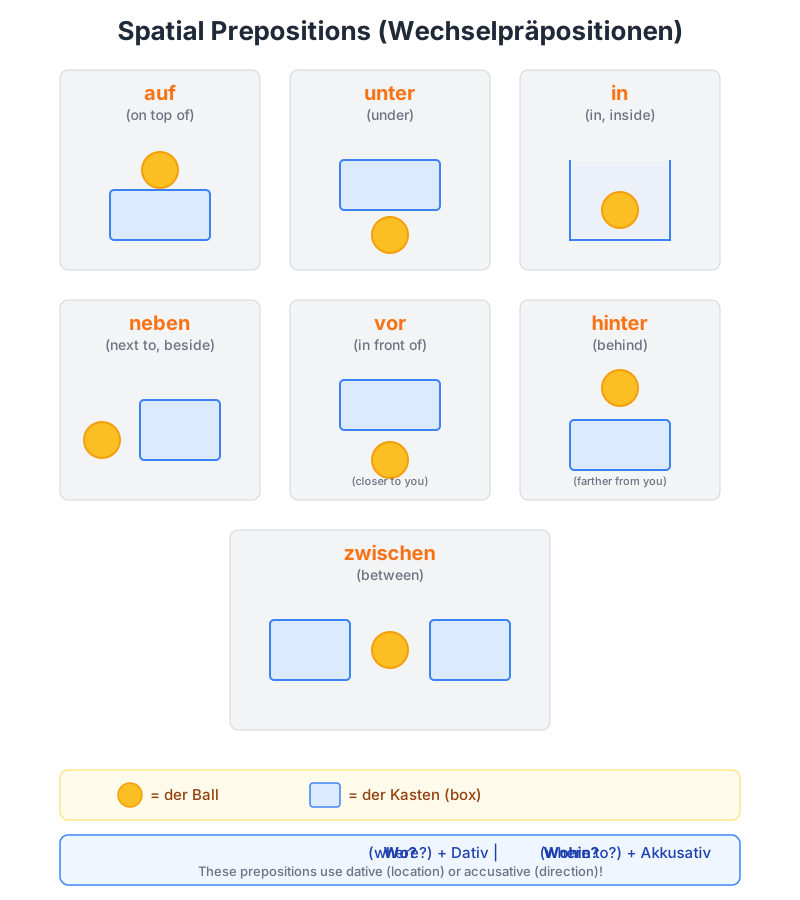
Learners mix up the cases: Ich bin in den Park (wrong — location needs dative: im Park).
🇬🇧 English speakers: English speakers have no movement-vs-location distinction for prepositions, making the accusative/dative choice completely unfamiliar.
Common Error Patterns
Incorrect number word form or usage
Review number patterns and exceptions (eins as standalone vs ein before nouns)
Wrong time expression format
Review formal (14:30 Uhr) vs informal (halb drei) time expressions
Incorrect spelling based on pronunciation rules
Review German spelling conventions: ie=[iː], ei=[aɪ], ß after long vowels, ss after short vowels
Ich gehe in den Supermarkt.
I am going to the supermarket.
Movement (wohin?) → accusative: in den (masculine).
Das Buch liegt auf dem Tisch.
The book is lying on the table.
Location (wo?) → dative: auf dem (masculine).
Sie hängt das Bild an die Wand.
She is hanging the picture on the wall.
Movement (wohin?) → accusative: an die (feminine).
Practice in course
Apply this grammar in A1 course exercises
Frequently asked questions
- When is Wechselpräpositionen used?
- Neun Präpositionen — die Wechselpräpositionen — können sowohl Akkusativ als auch Dativ verlangen.
- How is Wechselpräpositionen formed?
- Regel: Wohin? (Bewegung/Richtung) → Akkusativ : Ich gehe in den Park. Wo? (Ort/Position) → Dativ : Ich bin im (= in dem) Park. Kurzformen: in dem = im , in das = ins , an dem = am , an das = ans .
- What are common mistakes with Wechselpräpositionen?
- Learners mix up the cases: Ich bin in den Park (wrong — location needs dative: im Park). 🇬🇧 English speakers: English speakers have no movement-vs-location distinction for prepositions, making the accusative/dative choice completely unfamiliar. 🇷🇺 Russian speakers: Russian speakers understand directional vs. locative distinctions (Russian has a locative case) but the specific preposition behaviors differ. 🇨🇿 Czech speakers: Czech speakers have some movement-vs-location preposition patterns but the systematic accusative/dative split is stricter in German than Czech.