CasesA1
Akkusativ: Einführung
Introduction to the accusative case
Learning Goal
Can use the accusative case for direct objects
Exam Skills:ReadingWritingSpeaking
Look at these examples. Can you spot the grammar pattern?
Ich kaufe den Kuchen.
I buy the cake.
Siehst du die Kirche?
Do you see the church?
Er braucht einen Computer.
He needs a computer.
Pay attention to the highlighted parts. What do they have in common?
Der Akkusativ markiert das direkte Objekt — die Person oder Sache, die direkt von der Handlung betroffen ist.
Artikelveränderung im Akkusativ:
| Maskulin | Feminin | Neutrum | Plural | |
|---|---|---|---|---|
| Nominativ | der / ein | die / eine | das / ein | die |
| Akkusativ | den / einen | die / eine | das / ein | die |
Nur maskulin ändert sich! Der → den, ein → einen. Feminin, neutrum und Plural bleiben gleich.
Verben mit Akkusativ: haben, kaufen, sehen, essen, trinken, lesen, brauchen, suchen, finden, nehmen.
Beispiele: Ich sehe den Mann. Er kauft einen Kuchen. Wir lesen das Buch. (neutrum bleibt gleich).
Apply this grammar in A1 course exercises
Practice Exercises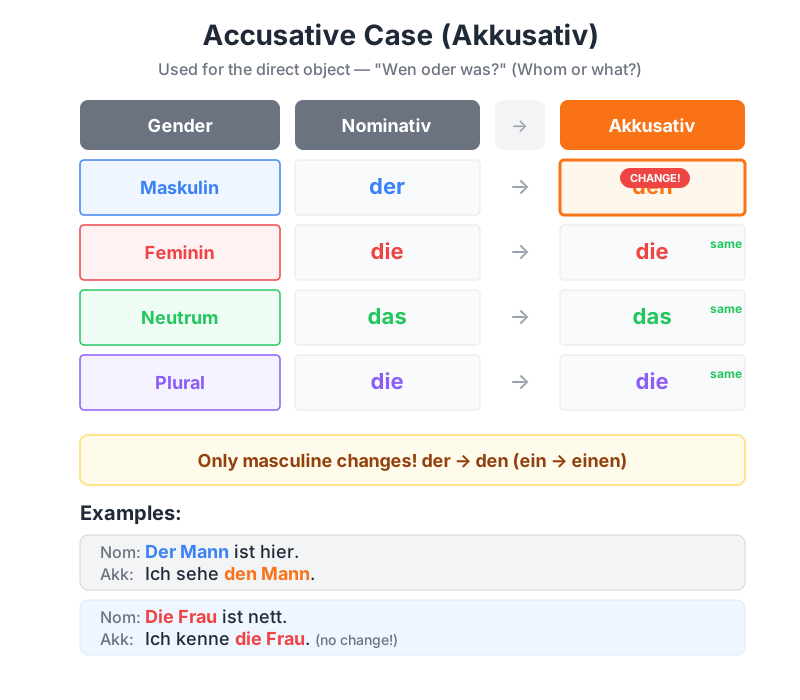
Learners forget that only masculine changes in accusative. Der Hund → Ich sehe den Hund, but die Katze → Ich sehe die Katze (no change).
🇬🇧 English speakers: English speakers have no case system at all, so remembering that only masculine articles change (der→den, ein→einen) is a major challenge.
Common Error Patterns
Didn't change article to accusative form
Only masculine changes: der→den, ein→einen, kein→keinen. Feminine/neuter/plural stay the same!
Used nominative form for direct object
Direct objects take accusative. Find the verb and ask 'wen/was?' to identify the direct object
Wrong gender leads to wrong accusative article
First determine the noun's gender, then apply accusative: der Hund→den Hund, die Katze→die Katze
Ich kaufe den Kuchen.
I buy the cake.
Kuchen is masculine: der → den in accusative.
Siehst du die Kirche?
Do you see the church?
Kirche is feminine: die stays die in accusative.
Er braucht einen Computer.
He needs a computer.
Computer is masculine: ein → einen in accusative.
Practice in course
Apply this grammar in A1 course exercises
Frequently asked questions
- When is Akkusativ: Einführung used?
- Der Akkusativ markiert das direkte Objekt — die Person oder Sache, die direkt von der Handlung betroffen ist.
- How is Akkusativ: Einführung formed?
- Nur maskulin ändert sich! Der → den , ein → einen . Feminin, neutrum und Plural bleiben gleich. Verben mit Akkusativ: haben, kaufen, sehen, essen, trinken, lesen, brauchen, suchen, finden, nehmen . Beispiele: Ich sehe den Mann. Er kauft einen Kuchen. Wir lesen das Buch. (neutrum bleibt gleich).
- What are common mistakes with Akkusativ: Einführung?
- Learners forget that only masculine changes in accusative. Der Hund → Ich sehe den Hund, but die Katze → Ich sehe die Katze (no change). 🇬🇧 English speakers: English speakers have no case system at all, so remembering that only masculine articles change (der→den, ein→einen) is a major challenge. 🇷🇺 Russian speakers: Russian speakers understand cases well (Russian has 6 cases) but may apply Russian accusative rules — in Russian, feminine also changes in accusative. 🇨🇿 Czech speakers: Czech speakers understand accusative well but may apply Czech patterns where more genders change in accusative than in German.