Estructura de oracionesA1
Nebensatz mit 'weil'
Subordinate clauses with weil — verb goes to end
Objetivo de aprendizaje
Can give reasons using weil with verb-final order
Competencias para el examen:Comprensión lectoraExpresión escritaExpresión oral
Mira estos ejemplos. Puedes identificar el patrón gramatical?
Ich lerne Deutsch, weil ich in Berlin arbeite.
I am learning German because I work in Berlin.
Weil das Wetter schön ist, gehen wir spazieren.
Because the weather is nice, we are going for a walk.
Er kommt nicht, weil er keine Zeit hat.
He is not coming because he has no time.
Presta atención a las partes resaltadas. Qué tienen en común?
Weil (because) leitet einen Nebensatz ein — das konjugierte Verb wandert ans Satzende.
Wortstellung im Nebensatz:
| Hauptsatz | Nebensatz (weil) |
|---|---|
| Ich bleibe zu Hause, | weil ich krank bin. |
| Er lernt Deutsch, | weil er in Berlin arbeitet. |
| Sie kommt nicht, | weil sie keine Zeit hat. |
Weil-Satz am Anfang: Wenn der Nebensatz zuerst kommt, folgt das Hauptsatz-Verb direkt nach dem Komma: Weil es regnet, nehme ich einen Schirm.
Weil vs. denn: Gleiche Bedeutung, aber verschiedene Wortstellung: ..., weil ich müde bin (Verb am Ende) vs. ..., denn ich bin müde (Verb an Position 2).
Aplica esta gramática en los ejercicios del curso A1
Ejercicios de práctica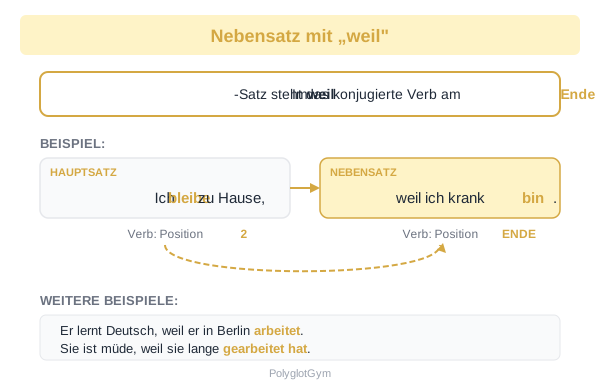
Learners keep normal word order after weil: weil ich bin krank instead of weil ich krank bin. The verb must go to the end.
🇬🇧 English speakers: English speakers keep V2 word order after 'weil': 'weil ich bin krank' instead of 'weil ich krank bin' — English 'because' doesn't change word order.
Patrones de errores comunes
Verb in second position instead of final in weil-clause
In weil-clauses, the verb goes to the END: Ich bleibe, WEIL ich krank BIN (not: weil ich bin krank)
Missing comma before subordinating conjunction
Always put a comma before weil, dass, wenn, ob, etc.
Confused weil (subordinating) with denn (coordinating)
weil = verb final: ...weil ich müde BIN. denn = normal V2: ...denn ich BIN müde
Ich lerne Deutsch, weil ich in Berlin arbeite.
I am learning German because I work in Berlin.
After weil, the verb arbeite goes to the end of the clause.
Weil das Wetter schön ist, gehen wir spazieren.
Because the weather is nice, we are going for a walk.
Weil-clause first: verb ist at the end. Main clause: verb gehen right after comma.
Er kommt nicht, weil er keine Zeit hat.
He is not coming because he has no time.
Hat goes to the end of the weil-clause.
Practicar en el curso
Aplica esta gramática en los ejercicios del curso A1