VerbosA1
Das Verb 'sein'
Conjugation and usage of sein (to be)
Objetivo de aprendizaje
Can describe people and things using the verb sein
Competencias para el examen:Expresión escritaExpresión oral
Mira estos ejemplos. Puedes identificar el patrón gramatical?
Ich bin Student.
I am a student.
Seid ihr müde?
Are you (all) tired?
Das ist mein Bruder.
That is my brother.
Mir ist kalt.
I'm cold.
Presta atención a las partes resaltadas. Qué tienen en común?
Sein (to be) ist das wichtigste Verb im Deutschen — und völlig unregelmäßig.
| Person | Form | Person | Form |
|---|---|---|---|
| ich | bin | wir | sind |
| du | bist | ihr | seid |
| er/sie/es | ist | sie/Sie | sind |
Verwendung: Sein beschreibt Identität, Herkunft, Beruf und Eigenschaften: Ich bin Anna. Er ist Lehrer. Wir sind müde.
Als Hilfsverb: Im Perfekt verwenden Bewegungsverben sein: Ich bin gegangen. Er ist gefahren.
Tipp: Nach sein steht der Nominativ (nicht Akkusativ): Das ist ein guter Mann.
Idiomatische Ausdrücke mit Dativ + sein: Im Deutschen verwendet man sein mit dem Dativ, um körperliche und emotionale Zustände auszudrücken — anders als im Englischen (wo man have/feel verwendet):
- Mir ist kalt. — I'm cold. (wörtl.: To me is cold.)
- Mir ist schlecht. — I feel sick.
- Mir ist langweilig. — I'm bored.
- Es ist mir egal. — I don't care.
- Mir ist warm. — I'm warm.
- Ihr ist schwindelig. — She's dizzy.
Muster: Dativpronomen + ist + Adjektiv. Verwechseln Sie nicht mit haben: Mir ist kalt (richtig) — nicht Ich habe kalt (falsch!).
Formen von sein in allen Zeiten (Überblick):
| Zeit | Beispiel | Thema |
|---|---|---|
| Präsens | ich bin, du bist, er ist | diese Seite |
| Präteritum | ich war, du warst, er war | Präteritum sein/haben |
| Perfekt | ich bin gewesen | Perfekt mit sein |
| Plusquamperfekt | ich war gewesen | Plusquamperfekt |
| Futur I | ich werde sein | Futur |
Die Grundform (der Infinitiv) ist sein - auch zu „ich bin": Die Frage „Was ist die Grundform von bin?" beantwortet sich also mit sein.
Aplica esta gramática en los ejercicios del curso A1
Ejercicios de práctica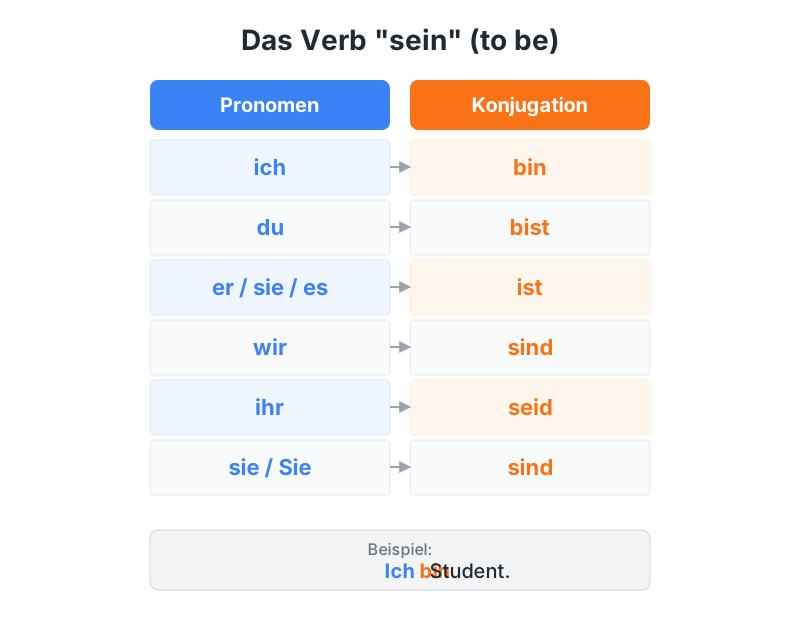
Learners often say ich bin from Germany instead of ich bin aus Deutschland, or forget that sein has no regular pattern at all.
🇬🇧 English speakers: English speakers may add articles with professions: 'Ich bin ein Lehrer' (influenced by 'I am a teacher') instead of 'Ich bin Lehrer'.
Patrones de errores comunes
Incorrect verb ending for the subject
Review verb conjugation tables and practice matching endings to pronouns
Forgot stem vowel change in irregular verbs
Practice stem-changing verbs (e→i, e→ie, a→ä) with flashcards
Verb placed in wrong position
Remember: V2 in main clauses, verb-final in subordinate clauses
Ich bin Student.
I am a student.
No article before professions after sein: Ich bin Student (not ein Student).
Seid ihr müde?
Are you (all) tired?
Ihr seid — the informal plural form of sein.
Das ist mein Bruder.
That is my brother.
Das ist... is used to introduce or point out people and things.
Mir ist kalt.
I'm cold.
Dative + sein for physical states: Mir ist kalt (not Ich habe kalt!). Literally: 'To me is cold.'
Mir ist schlecht. Ich gehe nach Hause.
I feel sick. I'm going home.
Mir ist schlecht — another Dativ + sein idiom for physical/emotional states.
Es ist mir egal.
I don't care.
Es ist mir egal — a common idiomatic expression with Dativ + sein meaning indifference.
Practicar en el curso
Aplica esta gramática en los ejercicios del curso A1