VerbosA2
Slovesa pohybu – jít/jet, chodit/jezdit
Determinate vs indeterminate motion: jít/jet for one direction now, chodit/jezdit for habits, plus the futures půjdu/pojedu
Objetivo de aprendizado
I can distinguish one-way and habitual motion on foot or by vehicle and form the futures půjdu and pojedu.
Habilidades para exame:CCE-A2 mluveníCCE-A2 poslech
Observe estes exemplos. Você consegue identificar o padrão gramatical?
Každou neděli chodíme s dětmi na Petřín.
Every Sunday we go with the children to Petřín hill.
Teď nemůžu mluvit, jedu tramvají na nádraží.
I can't talk now, I'm on the tram to the station.
V létě pojedeme na Moravu a půjdeme na vinobraní.
In the summer we will go to Moravia and walk to the wine harvest festival.
Preste atenção às partes destacadas. O que elas têm em comum?
Čeština rozlišuje pohyb pěšky a dopravním prostředkem a zároveň jeden směr teď a opakovaně:
| teď, jedním směrem | opakovaně, zvyk | |
|---|---|---|
| pěšky | jít (jdu) | chodit (chodím) |
| dopravou | jet (jedu) | jezdit (jezdím) |
Jdu do práce. (právě teď) × Chodím do práce pěšky. (každý den)
Jedu do Brna. (dnes) × Jezdím do Brna každý pátek.
Budoucí čas: půjdu, pojedu (bez budu!): Zítra půjdu na úřad. V létě pojedeme k moři.
Aplique esta gramática nos exercícios do curso A2
Exercícios de prática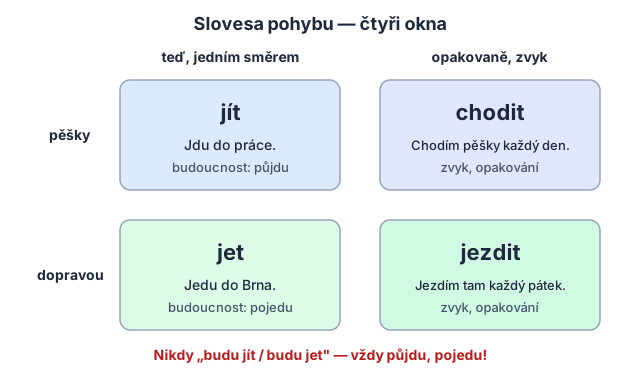
- *budu jít → půjdu; *budu jet → pojedu
- jít used for vehicles: *jdu autobusem → jedu autobusem
- One-way verb for habits: *Jdu do práce každý den → Chodím do práce každý den
Padrões de erros comuns
jít used with vehicles or jet on foot
Vehicle in the sentence → jet/jezdit, always
One-way verb used for habits or vice versa
každý den/často → chodit/jezdit; teď/dnes one direction → jít/jet
budu + jít/jet instead of půjdu/pojedu
Motion futures use the prefix: půjdu, pojedu, poletím
Každou neděli chodíme s dětmi na Petřín.
Every Sunday we go with the children to Petřín hill.
Habit (každou neděli) → chodit, the indeterminate verb.
Teď nemůžu mluvit, jedu tramvají na nádraží.
I can't talk now, I'm on the tram to the station.
One direction right now, by vehicle → jet: jedu tramvají.
V létě pojedeme na Moravu a půjdeme na vinobraní.
In the summer we will go to Moravia and walk to the wine harvest festival.
Futures without budu: pojedeme (by vehicle), půjdeme (on foot).
Praticar no curso
Aplique esta gramática nos exercícios do curso A2