CáchA1
Akkusativ: Einführung
Introduction to the accusative case
Mục tiêu học tập
Can use the accusative case for direct objects
Kỹ năng thi cử:ĐọcViếtNói
Hãy xem các ví dụ sau. Bạn có nhận ra quy tắc ngữ pháp không?
Ich kaufe den Kuchen.
I buy the cake.
Siehst du die Kirche?
Do you see the church?
Er braucht einen Computer.
He needs a computer.
Chú ý các phần được đánh dấu. Chúng có điểm gì chung?
English still has a trace of case: you say "I see him", not "I see he". German keeps that idea alive for nouns too, but it shows the case on the article rather than on the noun. The Akkusativ marks the direct object - the person or thing the action lands on: what you buy, eat, see, need or look for.
| Masculine | Feminine | Neuter | Plural | |
|---|---|---|---|---|
| Nominative (subject) | der / ein | die / eine | das / ein | die |
| Accusative (object) | den / einen | die / eine | das / ein | die |
The good news is in the table: among the articles, only the masculine singular changes. Der becomes den, ein becomes einen, and kein follows with keinen. Feminine, neuter and plural look exactly as they do in the nominative.
| German | English |
|---|---|
| Ich kaufe den Kuchen. | I'm buying the cake. (der Kuchen) |
| Er braucht einen Computer. | He needs a computer. (der Computer) |
| Siehst du die Kirche? | Can you see the church? (die Kirche - no change) |
| Wir lesen das Buch. | We're reading the book. (das Buch - no change) |
Why the ending matters more than the word order
Because the article carries the case, German can move the object to the front without changing who does what. Den Apfelstrudel esse ich. still means "I'm eating the apple strudel" - the den tells you the strudel is the object. In English, word order alone does that job, which is why English speakers tend to ignore the article and then say *Ich habe ein Hund. The fix is to learn every masculine noun with its article and to ask, each time: is this the thing being acted on?
Verbs you will meet with an accusative object at A1: haben, kaufen, sehen, essen, trinken, lesen, brauchen, suchen, finden, nehmen, besuchen. At the Bäckerei: Ich nehme einen Berliner und ein Brötchen.
Áp dụng ngữ pháp này vào các bài tập khóa học A1
Bài tập thực hành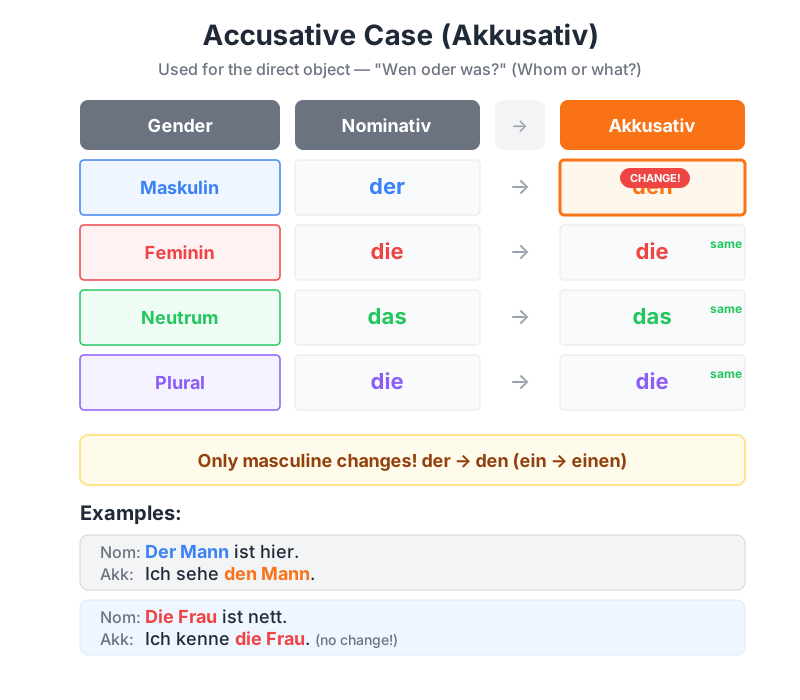
Learners forget that only masculine changes in accusative. Der Hund → Ich sehe den Hund, but die Katze → Ich sehe die Katze (no change).
🇬🇧 English speakers: English speakers have no case system at all, so remembering that only masculine articles change (der→den, ein→einen) is a major challenge.
Ich kaufe den Kuchen.
I buy the cake.
Kuchen is masculine: der → den in accusative.
Siehst du die Kirche?
Do you see the church?
Kirche is feminine: die stays die in accusative.
Er braucht einen Computer.
He needs a computer.
Computer is masculine: ein → einen in accusative.
Bài kiểm tra cho chủ đề này đang được chuẩn bị
Hỏi Sofi
Luyện tập trong khóa học
Áp dụng ngữ pháp này vào các bài tập khóa học A1