CáchA2
Dativ vollständig
Full dative declension with all article types, pronouns, and dative verbs
Mục tiêu học tập
Can apply dative endings and use dative verbs correctly
Kỹ năng thi cử:ĐọcViếtNói
Hãy xem các ví dụ sau. Bạn có nhận ra quy tắc ngữ pháp không?
Das Buch gehört meiner Schwester.
The book belongs to my sister.
Ich gebe ihm das Geld.
I give him the money.
Die Pizza schmeckt den Kindern gut.
The children like the pizza.
Kannst du mir bitte helfen?
Can you please help me?
Chú ý các phần được đánh dấu. Chúng có điểm gì chung?
The dative case marks the indirect object — the recipient or beneficiary of an action.
| Maskulin | Feminin | Neutrum | Plural | |
|---|---|---|---|---|
| bestimmt | dem | der | dem | den + -n |
| unbestimmt | einem | einer | einem | — |
| Negation | keinem | keiner | keinem | keinen + -n |
| Possessiv | meinem | meiner | meinem | meinen + -n |
Personal pronouns: ich→mir, du→dir, er→ihm, sie→ihr, es→ihm, wir→uns, ihr→euch, sie/Sie→ihnen/Ihnen.
Dative-only verbs (must memorize): helfen, danken, gefallen, gehören, schmecken, fehlen, folgen, gratulieren, antworten, passen, glauben.
Plural dative rule: All plural nouns add -n if they don't already end in -n or -s: die Kinder → den Kindern.
Áp dụng ngữ pháp này vào các bài tập khóa học A2
Bài tập thực hành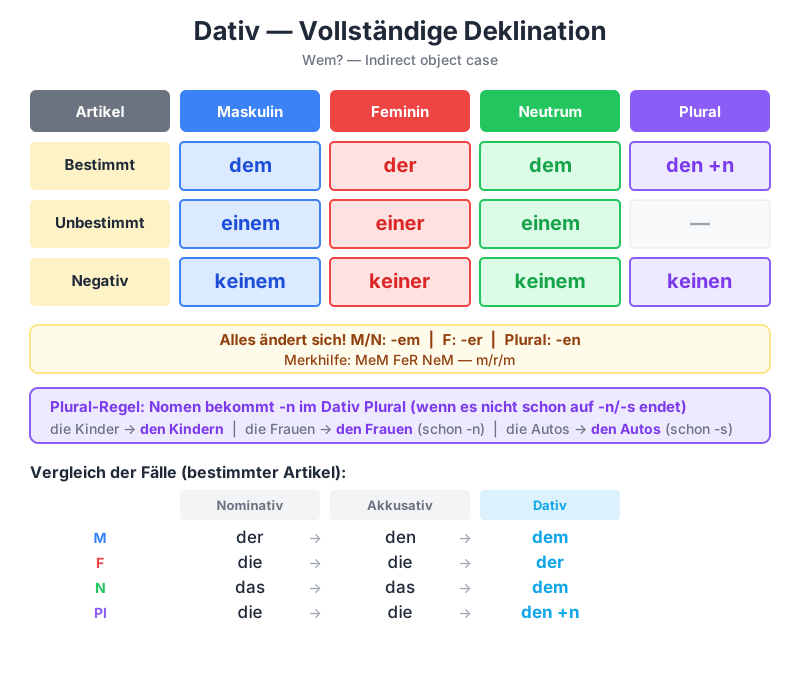
- Accusative after dative verbs: ✗ Ich helfe dich → ✓ Ich helfe dir.
- Forgetting plural -n: ✗ mit den Kinder → ✓ mit den Kindern.
- Confusing der (fem. dat.) with der (masc. nom.): Context matters.
Các lỗi thường gặp
Incorrect number word form or usage
Review number patterns and exceptions (eins as standalone vs ein before nouns)
Wrong time expression format
Review formal (14:30 Uhr) vs informal (halb drei) time expressions
Incorrect spelling based on pronunciation rules
Review German spelling conventions: ie=[iː], ei=[aɪ], ß after long vowels, ss after short vowels
Das Buch gehört meiner Schwester.
The book belongs to my sister.
Gehören + dative: meine→meiner (fem. dat.).
Ich gebe ihm das Geld.
I give him the money.
Ihm = dative of er. Geben takes dat + acc.
Die Pizza schmeckt den Kindern gut.
The children like the pizza.
Schmecken + dative: die Kinder → den Kindern.
Kannst du mir bitte helfen?
Can you please help me?
Helfen + dative: ich→mir.
Der Pullover passt dem Jungen nicht.
The sweater doesn't fit the boy.
Passen + dative: der Junge → dem Jungen.
Luyện tập trong khóa học
Áp dụng ngữ pháp này vào các bài tập khóa học A2