Động từA1
Modalverb 'können'
können for ability and possibility
Mục tiêu học tập
Can express ability and ask for permission with können
Kỹ năng thi cử:ViếtNói
Hãy xem các ví dụ sau. Bạn có nhận ra quy tắc ngữ pháp không?
Ich kann Deutsch sprechen.
I can speak German.
Kannst du mir helfen?
Can you help me?
Hier kann man gut essen.
You can eat well here.
Chú ý các phần được đánh dấu. Chúng có điểm gì chung?
Können drückt Fähigkeit (can) oder Möglichkeit aus.
| Person | Form | Person | Form |
|---|---|---|---|
| ich | kann | wir | können |
| du | kannst | ihr | könnt |
| er/sie/es | kann | sie/Sie | können |
Satzstruktur: Modalverb an Position 2, Infinitiv am Ende: Ich kann gut schwimmen.
Verwendung:
| Funktion | Beispiel |
|---|---|
| Fähigkeit | Er kann Deutsch sprechen. |
| Möglichkeit | Wir können morgen kommen. |
| Höfliche Bitte | Können Sie mir helfen? |
Merkmal: Ich und er/sie/es haben die gleiche Form — ohne Endung.
Áp dụng ngữ pháp này vào các bài tập khóa học A1
Bài tập thực hành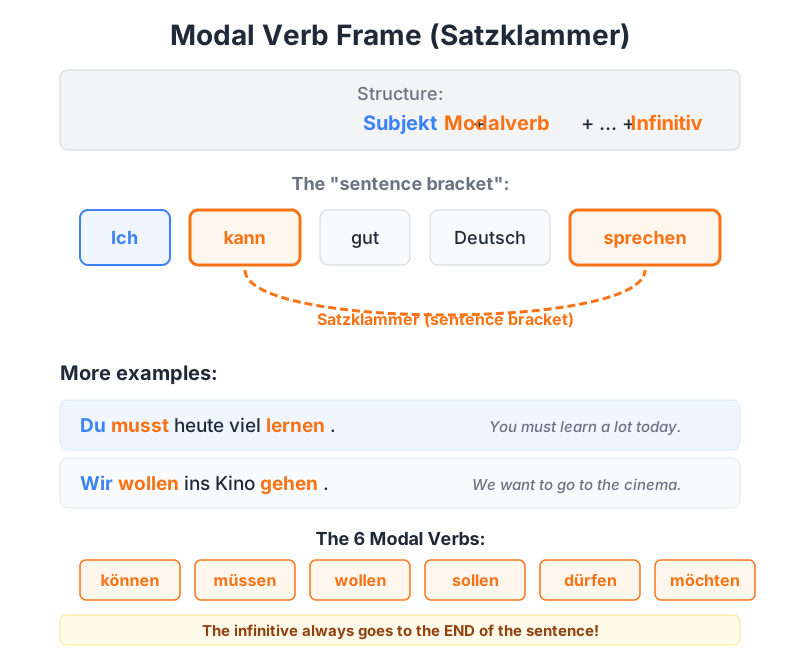
Learners conjugate both verbs: Ich kann schwimme instead of Ich kann schwimmen (infinitive at the end).
🇬🇧 English speakers: English speakers conjugate both verbs: 'Ich kann schwimme' instead of 'Ich kann schwimmen' — English 'can swim' uses bare infinitive but German needs the full infinitive.
Các lỗi thường gặp
Wrong modal verb conjugation
können: ich kann, du kannst, er kann, wir können. Note: no ending for ich/er forms!
Main verb not at end of sentence
Modal sentence bracket: Ich KANN gut Deutsch SPRECHEN. Modal conjugated in V2, infinitive at end.
Confused können (ability) with dürfen (permission)
können = can (ability/possibility), dürfen = may (permission). Ich kann schwimmen vs Ich darf hier schwimmen
Ich kann Deutsch sprechen.
I can speak German.
Kann at position 2, sprechen (infinitive) at the end.
Kannst du mir helfen?
Can you help me?
Polite request: kannst du + infinitive helfen at the end.
Hier kann man gut essen.
You can eat well here.
Man (one/you) + kann for general statements about possibility.
Luyện tập trong khóa học
Áp dụng ngữ pháp này vào các bài tập khóa học A1