PolyglotGym
课程语法词汇
登录创建账号
课程语法词汇

更多

书库社区

界面语言

创建账号登录
PolyglotGym
所有语言课程语法

下载应用

下载于App Store
PolyglotGym

通过互动课程、词汇训练等方式在线学习英语。

学习

  • 所有语言
  • 课程
  • 语法
  • 词汇
  • 词汇对齐

社区

  • 书库
  • 论坛
  • 学习小组

下载应用

随时随地学习

下载于App Store

© 2026 PolyglotGym. 版权所有

隐私政策服务条款

课程语法词汇
  1. 首页
  2. ›语法
  3. ›A1
  4. ›Past simple: irregular verbs
你在这里
动词A1

Past simple: irregular verbs

The core irregular set (went, had, said, got, made, saw...) and was/were as the past of be

学习目标

I can use the core irregular pasts and was/were fluently in stories and questions.

考试技能:Key A2 · 听力Key A2 · 口语

观察以下示例,你能发现语法规律吗?

We went to Edinburgh, saw the castle and ate too much shortbread.

We went to Edinburgh, saw the castle and ate too much shortbread.

Where were you? I was at home — I had a cold.

Where were you? I was at home — I had a cold.

注意高亮部分,它们有什么共同点?

The 20 most useful irregular pasts:

go→wenthave→hadsay→saidget→got
make→madesee→sawcome→cametake→took
know→knewgive→gavefind→foundthink→thought
tell→toldbuy→boughteat→atedrink→drank
write→wroteread→read [red]do→didbe→was/were

Negatives and questions still use did + base form: I didn't go. Did she see it? Only be works alone: I wasn't there. Were you?

在 A1 课程练习中应用此语法

练习题
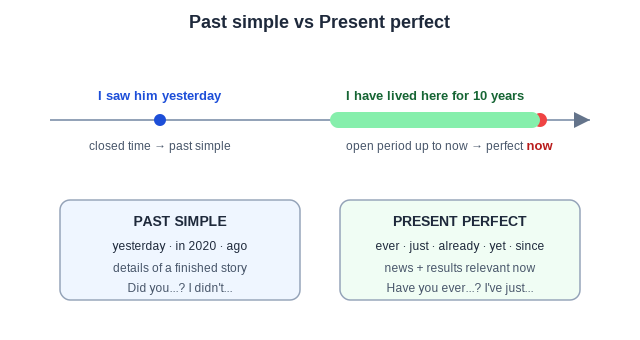
Past simple: irregular verbs: The core irregular set (went, had, said, got, made, saw...) and was/were as the past of be
  • *goed, *taked → went, took
  • *didn't went → didn't go
  • *Did you was...? → Were you...?

We went to Edinburgh, saw the castle and ate too much shortbread.

We went to Edinburgh, saw the castle and ate too much shortbread.

Three irregular pasts in one trip.

Where were you? I was at home — I had a cold.

Where were you? I was at home — I had a cold.

was/were question and answer without did.

这个主题的检测还在准备中

问问索菲

在课程中练习

在 A1 课程练习中应用此语法

A1 课程
← 返回主题列表

Put it into practice

Try a free exercise from the course

相关主题

上一个主题:Past simple: regular verbs下一个主题:Have got

同类主题 动词

  • The verb be (am/is/are)
  • Present simple
  • Present continuous
  • Can: ability and requests
  • Past simple: regular verbs
  • Have got
  • Like, love, hate + -ing
  • Present perfect: have doneA2
  • Future: will vs going toA2
  • Past continuousA2
  • The imperativeA2
  • Obligation: must, have to, mustn't, don't have toA2
  • Should and shouldn't: adviceA2
  • Could: past ability and polite requestsA2
  • State verbs: know, want, believeA2
  • Present perfect vs past simpleB1
  • The passive voiceB1
  • Present tenses for the futureB1
  • Past perfect: had doneB1
  • Present perfect continuous: have been doingB1
  • May, might, could: possibilityB1
  • Ought to, had better, be supposed toB1
  • Phrasal verbs: an introductionB1
  • Verb + object + infinitive: want her to comeB1
  • wish and if onlyB2
  • Advanced passive: get-passive and have something doneB2
  • Modals of deduction: must have, can't have, might haveB2
  • Gerund vs infinitiveB2
  • used to and would for past habitsB2
  • Future perfect and future continuousB2
  • Narrative tenses: the storytelling kitB2
  • The subjunctive: I suggest he beC1
  • Phrasal verb grammar: separability and particlesC1
  • Advanced conditionals: but for, should you, were toC1
  • Passive reporting: he is said to...C1

语法 A1·语法参考