PolyglotGym
课程语法词汇
登录创建账号
课程语法词汇

更多

书库社区

界面语言

创建账号登录
PolyglotGym
所有语言课程语法

下载应用

下载于App Store
PolyglotGym

通过互动课程、词汇训练等方式在线学习英语。

学习

  • 所有语言
  • 课程
  • 语法
  • 词汇
  • 词汇对齐

社区

  • 书库
  • 论坛
  • 学习小组

下载应用

随时随地学习

下载于App Store

© 2026 PolyglotGym. 版权所有

隐私政策服务条款

课程语法词汇
  1. 首页
  2. ›语法
  3. ›A2
  4. ›Present perfect: have done
你在这里
动词A2

Present perfect: have done

have/has + past participle for experiences and results connected to now; ever, never, just, already, yet

学习目标

I can talk about experiences and present results with the present perfect and its markers.

考试技能:Key A2 · 听力Preliminary B1 · 阅读

观察以下示例,你能发现语法规律吗?

I've just made coffee — would you like a cup?

I've just made coffee — would you like a cup?

Have you ever tried haggis? — Never, and I'm not starting today.

Have you ever tried haggis? — Never, and I'm not starting today.

注意高亮部分,它们有什么共同点?

have/has + past participle links past events to now:

UseExample
experience (ever/never)Have you ever been to Wales?
result nowI've lost my keys (= I don't have them).
just / already / yetShe's just left. Have you finished yet?

No finished-time words: with yesterday, in 2020, last week switch to the past simple. American English also uses the past simple with just, already, yet and ever: I just ate. Did you eat yet? Did you ever go to Wales?

在 A2 课程练习中应用此语法

练习题
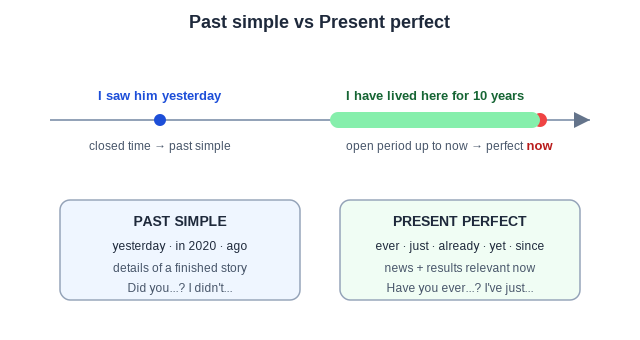
Present perfect: have done: have/has + past participle for experiences and results connected to now; ever, never, just, already, yet
  • Perfect + finished time: *I've seen him yesterday → I saw him yesterday
  • *Did you ever been...? → Have you ever been...?
  • gone vs been: He's gone to Rome (still there) × He's been to Rome (experience)

I've just made coffee — would you like a cup?

I've just made coffee — would you like a cup?

just + result relevant right now.

Have you ever tried haggis? — Never, and I'm not starting today.

Have you ever tried haggis? — Never, and I'm not starting today.

ever/never experience frame.

这个主题的检测还在准备中

问问索菲

在课程中练习

在 A2 课程练习中应用此语法

A2 课程
← 返回主题列表

相关主题

下一个主题:Future: will vs going to

同类主题 动词

  • The verb be (am/is/are)A1
  • Present simpleA1
  • Present continuousA1
  • Can: ability and requestsA1
  • Past simple: regular verbsA1
  • Past simple: irregular verbsA1
  • Have gotA1
  • Like, love, hate + -ingA1
  • Future: will vs going to
  • Past continuous
  • The imperative
  • Obligation: must, have to, mustn't, don't have to
  • Should and shouldn't: advice
  • Could: past ability and polite requests
  • State verbs: know, want, believe
  • Present perfect vs past simpleB1
  • The passive voiceB1
  • Present tenses for the futureB1
  • Past perfect: had doneB1
  • Present perfect continuous: have been doingB1
  • May, might, could: possibilityB1
  • Ought to, had better, be supposed toB1
  • Phrasal verbs: an introductionB1
  • Verb + object + infinitive: want her to comeB1
  • wish and if onlyB2
  • Advanced passive: get-passive and have something doneB2
  • Modals of deduction: must have, can't have, might haveB2
  • Gerund vs infinitiveB2
  • used to and would for past habitsB2
  • Future perfect and future continuousB2
  • Narrative tenses: the storytelling kitB2
  • The subjunctive: I suggest he beC1
  • Phrasal verb grammar: separability and particlesC1
  • Advanced conditionals: but for, should you, were toC1
  • Passive reporting: he is said to...C1

语法 A2·语法参考