介词C1
Genitivpräpositionen
The formal preposition shelf: infolge, angesichts, anlässlich, zugunsten, mangels, seitens, anhand; Dativ encroachment (wegen, trotz)
学习目标
I can deploy the formal genitive prepositions with correct case and meaning.
考试技能:阅读写作
观察以下示例,你能发现语法规律吗?
Infolge des Unwetters fielen anlässlich des Stadtfests alle Konzerte aus.
As a result of the storm, all the concerts for the town festival were cancelled.
Mangels Beweisen wurde das Verfahren seitens der Staatsanwaltschaft eingestellt.
For lack of evidence, the proceedings were discontinued by the prosecution.
注意高亮部分,它们有什么共同点?
Everyday German gets by with a handful of prepositions that take the genitive, and in speech even those slide toward the dative. Formal written German is a different world: newspaper reports, legal texts, official letters and academic writing use a whole shelf of genitive prepositions, many of them formed from nouns (infolge from Folge, anlässlich from Anlass). English renders most of them with multi-word phrases: "as a result of", "in view of", "on the occasion of".
| Preposition | English | Example |
|---|---|---|
| infolge | as a result of | infolge des Sturms |
| angesichts | in view of, given | angesichts der Lage |
| anlässlich | on the occasion of | anlässlich des Jubiläums |
| zugunsten / zulasten | in favour of / at the expense of | zugunsten der Kinder |
| mangels | for lack of | mangels Beweisen |
| seitens | on the part of | seitens der Behörde |
| anhand / mithilfe / mittels | by means of, using | anhand der Daten |
| hinsichtlich / bezüglich | regarding | hinsichtlich der Kosten |
| aufgrund | due to | aufgrund des Streiks |
Telling the near-synonyms apart
Infolge names a consequence, anlässlich an occasion. Infolge des Unwetters fielen anlässlich des Stadtfests alle Konzerte aus - as a result of the storm, all concerts for the town festival were cancelled. Aufgrund and wegen both give a reason; aufgrund sounds more official. Angesichts means "faced with, in view of" and introduces something the speaker takes into account: Angesichts der Inflation erhöht die EZB die Zinsen.
When the genitive is invisible
With a plural noun and no article, the genitive has no visible ending, so German switches to the dative: mangels Beweisen, mittels Drähten, infolge von Unfällen. This is standard, not a mistake. The same goes for wegen: wegen Bauarbeiten gesperrt on a Deutsche Bahn notice.
The dative creeping in
With wegen, trotz, während and statt the dative is widespread in speech (wegen dem Wetter), and Duden labels it colloquial rather than wrong. The formal prepositions in the table above resist this much more: *angesichts dem Problem or *infolge dem Sturm reads as a plain error to an editor. If you use the formal vocabulary, use the formal case with it.
English speakers also tend to translate "because of the storm" with infolge in casual speech. Register matters: in conversation wegen is the natural word, and infolge sounds like you are reading the news.
在 C1 课程练习中应用此语法
练习题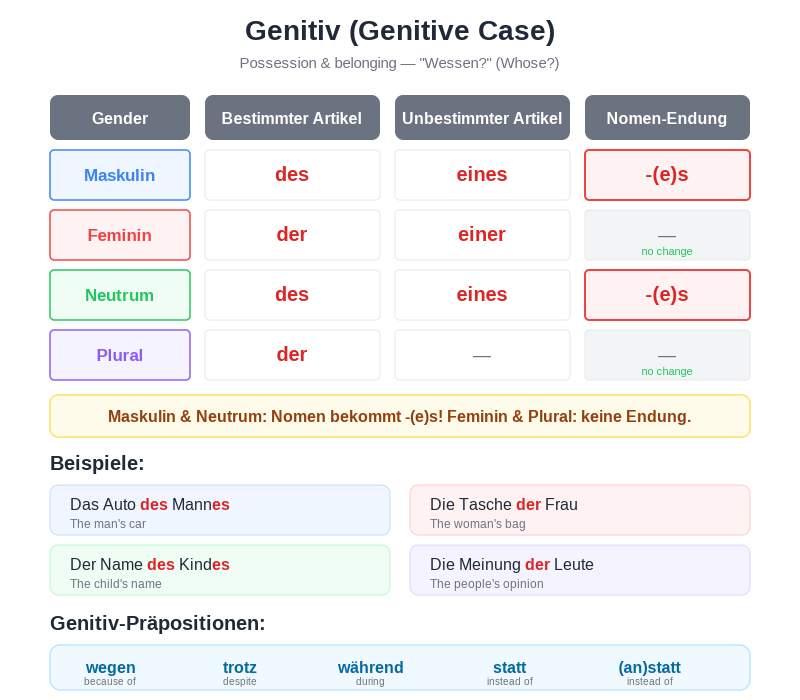
- Dativ after the formal set: infolge/angesichts keep Genitiv
- anlässlich/infolge mixed: occasion vs consequence
Infolge des Unwetters fielen anlässlich des Stadtfests alle Konzerte aus.
As a result of the storm, all the concerts for the town festival were cancelled.
infolge (consequence) + anlässlich (occasion) side by side.
Mangels Beweisen wurde das Verfahren seitens der Staatsanwaltschaft eingestellt.
For lack of evidence, the proceedings were discontinued by the prosecution.
mangels + bare plural Dativ; seitens + Genitiv.
这个主题的检测还在准备中
问问索菲
在课程中练习
在 C1 课程练习中应用此语法