介词A1
Wechselpräpositionen
Two-way prepositions: accusative vs. dative
学习目标
Can distinguish location and direction with two-way prepositions
考试技能:阅读写作口语
观察以下示例,你能发现语法规律吗?
Ich gehe in den Supermarkt.
I am going to the supermarket.
Das Buch liegt auf dem Tisch.
The book is lying on the table.
Sie hängt das Bild an die Wand.
She is hanging the picture on the wall.
注意高亮部分,它们有什么共同点?
English sometimes marks movement with a different preposition: you are in the park, but you walk into the park; the cup is on the table, but you put it onto the table. German keeps the same preposition and changes the case instead. Nine prepositions work like this - the Wechselpräpositionen, "switching prepositions".
| Preposition | Meaning | Preposition | Meaning |
|---|---|---|---|
| in | in, into | vor | in front of |
| an | at, on (a vertical surface) | hinter | behind |
| auf | on (a horizontal surface) | neben | next to |
| über | over, above | zwischen | between |
| unter | under |
The question test
| Question | Case | Example |
|---|---|---|
| Wohin? (where to? movement towards a place) | Accusative | Ich gehe in den Park. - I'm going into the park. |
| Wo? (where? location) | Dative | Ich bin im Park. - I'm in the park. |
| Wohin? | Accusative | Sie hängt das Bild an die Wand. - She hangs the picture on the wall. |
| Wo? | Dative | Das Bild hängt an der Wand. - The picture is hanging on the wall. |
The movement has to end up at the place named. Walking around inside the Englischer Garten is still location: Wir joggen im Englischen Garten (dative), because you stay inside it the whole time.
English speakers usually get the meaning right and the case wrong, saying *Ich bin in den Park because "in the park" sounds the same either way. Before you choose the article, ask: is anything moving towards a new place?
Short forms
These merges are standard in speech and writing: in dem = im, in das = ins, an dem = am, an das = ans. So: Wir gehen ins Kino (wohin?) and Wir sind im Kino (wo?). On a summer Saturday in Hamburg: Wir fahren an die Ostsee - and then Wir sind an der Ostsee.
在 A1 课程练习中应用此语法
练习题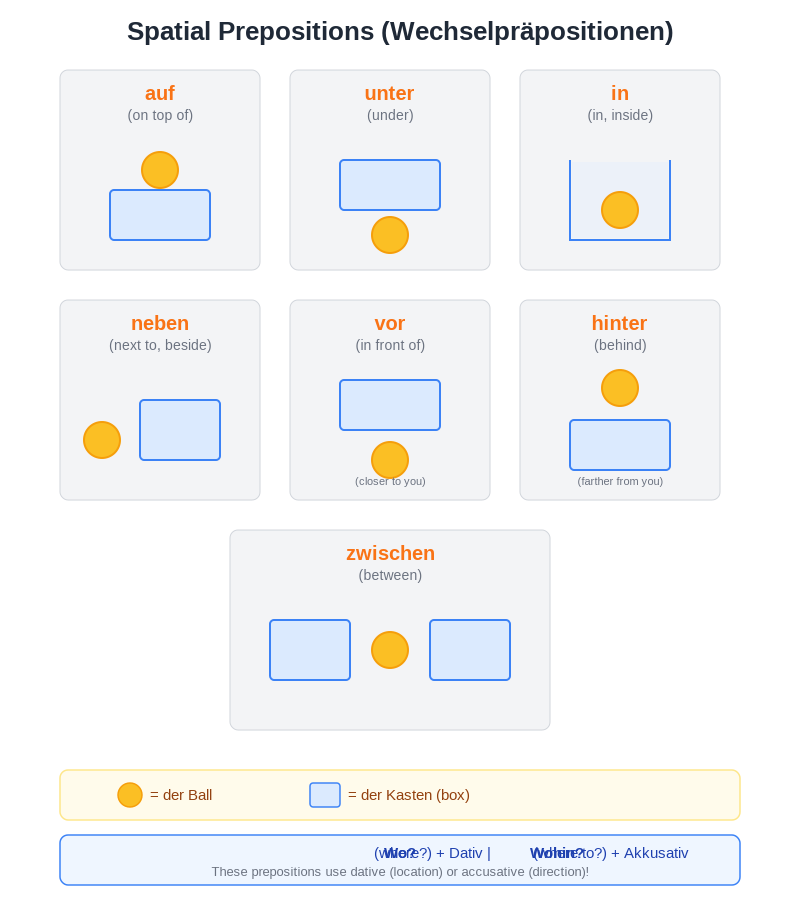
Learners mix up the cases: Ich bin in den Park (wrong — location needs dative: im Park).
🇬🇧 English speakers: English speakers have no movement-vs-location distinction for prepositions, making the accusative/dative choice completely unfamiliar.
Ich gehe in den Supermarkt.
I am going to the supermarket.
Movement (wohin?) → accusative: in den (masculine).
Das Buch liegt auf dem Tisch.
The book is lying on the table.
Location (wo?) → dative: auf dem (masculine).
Sie hängt das Bild an die Wand.
She is hanging the picture on the wall.
Movement (wohin?) → accusative: an die (feminine).
这个主题的检测还在准备中
问问索菲
在课程中练习
在 A1 课程练习中应用此语法