名词A1
Pluralbildung
Basic plural formation patterns in German
学习目标
Can form and recognize plural nouns in German
考试技能:阅读写作
观察以下示例,你能发现语法规律吗?
Die Kinder spielen im Park.
The children are playing in the park.
Ich habe zwei Brüder.
I have two brothers.
Die Autos sind teuer.
The cars are expensive.
注意高亮部分,它们有什么共同点?
English makes almost every plural with -s. German has several plural patterns, and the one a noun takes is part of what you learn with it, like its gender. A good dictionary lists it: der Tisch, -e means the plural is die Tische.
| Pattern | Ending | Singular → plural |
|---|---|---|
| 1 | -e (often with umlaut) | der Tisch → die Tische; die Stadt → die Städte |
| 2 | -(e)n | die Frau → die Frauen; die Blume → die Blumen |
| 3 | -er (umlaut where possible) | das Kind → die Kinder; das Haus → die Häuser |
| 4 | -s | das Auto → die Autos; das Hotel → die Hotels |
| 5 | no ending (sometimes umlaut) | der Lehrer → die Lehrer; der Bruder → die Brüder |
Tendencies that help
- Most feminine nouns take -(e)n: die Straße → die Straßen, die Zeitung → die Zeitungen.
- Masculine and neuter nouns ending in -er, -el, -en usually take no ending: der Koffer → die Koffer, der Löffel → die Löffel, der Wagen → die Wagen.
- Nouns ending in -chen and -lein do not change: das Brötchen → die Brötchen.
- -s is mostly for words from English and French, and for words ending in a vowel other than -e: die Handys, die Cafés, die Omas, die Kinos.
The English-speaker trap: -s everywhere
Because -s exists in German, it feels like a safe default. For native German words it is one of the least common patterns. *die Tischs, *die Kinds and *die Fraus are wrong. When you do not know the plural, look it up and say it aloud with the article: die Kinder, die Frauen.
The umlaut matters
Sometimes the umlaut is the one visible sign of the plural: der Vater → die Väter, die Mutter → die Mütter, der Apfel → die Äpfel. So Mutter and Mütter are different words, and Ich habe zwei Bruder is wrong; it is zwei Brüder.
One article for every plural
The plural article is die whatever the singular gender was: der Tisch → die Tische, das Kind → die Kinder. "A" has no plural, just as in English: ein Kind, but Kinder (children). In the dative plural, most nouns add an extra -n; you will meet that later (mit den Kindern).
在 A1 课程练习中应用此语法
练习题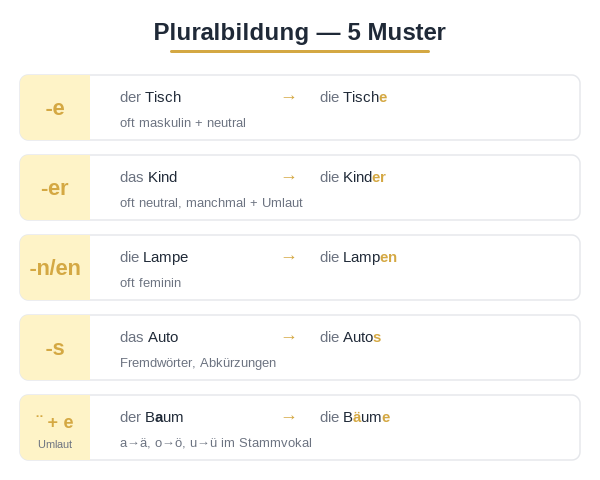
There is no single rule — learners must memorize the plural with each noun. Adding -s (as in English) rarely works.
🇬🇧 English speakers: English speakers default to adding -s for all plurals since that is the dominant English pattern, but German -s plurals are actually rare.
Die Kinder spielen im Park.
The children are playing in the park.
Kind → Kinder: -er plural pattern, all plurals take die.
Ich habe zwei Brüder.
I have two brothers.
Bruder → Brüder: umlaut change with no ending added.
Die Autos sind teuer.
The cars are expensive.
Auto → Autos: -s plural, common for foreign words.
这个主题的检测还在准备中
问问索菲
在课程中练习
在 A1 课程练习中应用此语法