冠词A1
Genus & bestimmte Artikel
German grammatical gender and der/die/das
学习目标
Can use der, die, das correctly with common nouns
考试技能:阅读写作口语
观察以下示例,你能发现语法规律吗?
Der Tisch ist groß.
The table is big.
Die Zeitung ist interessant.
The newspaper is interesting.
Das Mädchen spielt draußen.
The girl is playing outside.
注意高亮部分,它们有什么共同点?
English has one word for "the". German has three in the singular, because every noun belongs to one of three grammatical genders: masculine, feminine or neuter. The article tells you which.
| Masculine | Feminine | Neuter | Plural (all genders) |
|---|---|---|---|
| der Tisch - the table | die Lampe - the lamp | das Buch - the book | die Bücher - the books |
| der Mann - the man | die Frau - the woman | das Kind - the child | die Kinder - the children |
Gender is grammar, not biology
For people the grammatical gender usually matches: der Vater, die Mutter. For everything else it is a property of the word. A spoon is masculine (der Löffel), a fork feminine (die Gabel), a knife neuter (das Messer). Even people can surprise you: das Mädchen (the girl) is neuter because of its ending -chen. Mark Twain complained that in German "a young lady has no sex, while a turnip has". He had a point, and Germans still quote him.
Endings that help
| Ending | Gender | Examples |
|---|---|---|
| -ung, -heit, -keit, -schaft, -tion | feminine (die) | die Wohnung (flat), die Freiheit (freedom), die Station |
| -chen, -lein | neuter (das) | das Mädchen, das Brötchen (bread roll), das Fräulein |
| -er for people who do something | masculine (der) | der Lehrer (teacher), der Fahrer (driver) |
| -ismus, -ling | masculine (der) | der Tourismus, der Frühling (spring) |
The diminutives -chen and -lein make a noun neuter, whatever it was before: die Stadt becomes das Städtchen (small town), der Hund becomes das Hündchen (little dog).
Learn the article with the noun
Many genders have no visible logic, so learn every noun as a unit: not Tisch but der Tisch. Many learners use colours on their flashcards, blue for der, red for die, green for das. The effort pays off quickly, because the gender decides the shape of every article, adjective and pronoun that goes with the noun later.
One plural article
In the plural there is one article for every gender: die. Der Tisch - die Tische, das Kind - die Kinder. So a die in front of a noun can mean feminine singular or any plural; the noun's ending tells you which.
在 A1 课程练习中应用此语法
练习题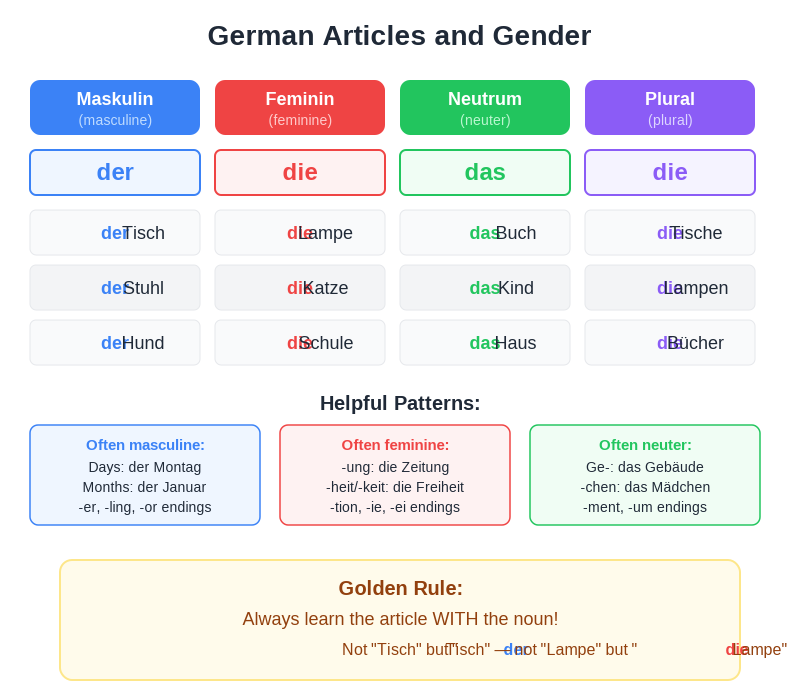
Learners try to guess gender from meaning, but it must be memorized. Das Mädchen (girl) is neuter because of the -chen suffix.
🇬🇧 English speakers: English speakers have no grammatical gender at all, so choosing der/die/das feels completely arbitrary and requires pure memorization.
Der Tisch ist groß.
The table is big.
Tisch is masculine — always der Tisch.
Die Zeitung ist interessant.
The newspaper is interesting.
Zeitung ends in -ung, so it is always feminine: die Zeitung.
Das Mädchen spielt draußen.
The girl is playing outside.
Mädchen ends in -chen, so it is neuter: das Mädchen.
这个主题的检测还在准备中
问问索菲
在课程中练习
在 A1 课程练习中应用此语法