CasesA2
Dativ vollständig
Full dative declension with all article types, pronouns, and dative verbs
Learning Goal
Can apply dative endings and use dative verbs correctly
Exam Skills:ReadingWritingSpeaking
Look at these examples. Can you spot the grammar pattern?
Das Buch gehört meiner Schwester.
The book belongs to my sister.
Ich gebe ihm das Geld.
I give him the money.
Die Pizza schmeckt den Kindern gut.
The children like the pizza.
Kannst du mir bitte helfen?
Can you please help me?
Pay attention to the highlighted parts. What do they have in common?
The dative case marks the indirect object — the recipient or beneficiary of an action.
| Maskulin | Feminin | Neutrum | Plural | |
|---|---|---|---|---|
| bestimmt | dem | der | dem | den + -n |
| unbestimmt | einem | einer | einem | — |
| Negation | keinem | keiner | keinem | keinen + -n |
| Possessiv | meinem | meiner | meinem | meinen + -n |
Personal pronouns: ich→mir, du→dir, er→ihm, sie→ihr, es→ihm, wir→uns, ihr→euch, sie/Sie→ihnen/Ihnen.
Dative-only verbs (must memorize): helfen, danken, gefallen, gehören, schmecken, fehlen, folgen, gratulieren, antworten, passen, glauben.
Plural dative rule: All plural nouns add -n if they don't already end in -n or -s: die Kinder → den Kindern.
Apply this grammar in A2 course exercises
Practice Exercises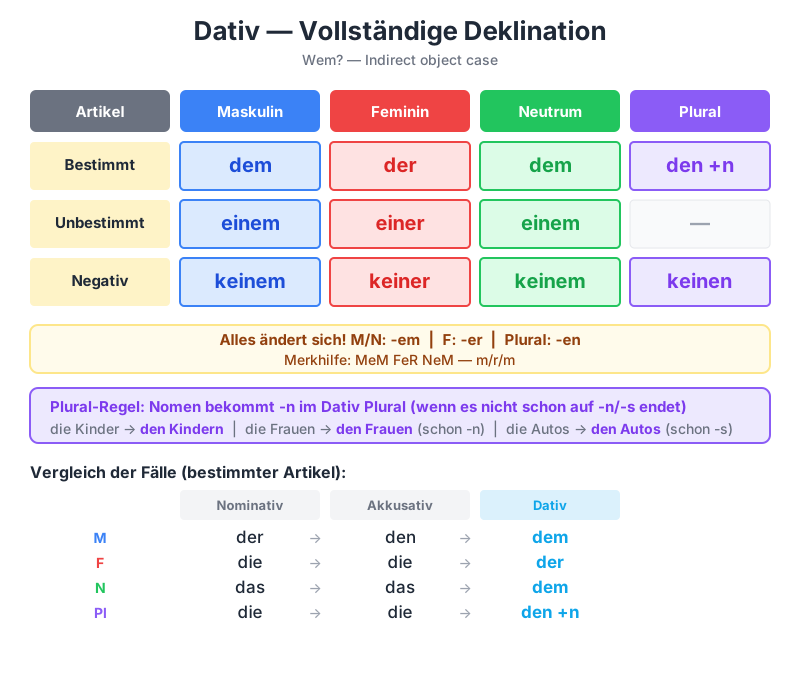
- Accusative after dative verbs: ✗ Ich helfe dich → ✓ Ich helfe dir.
- Forgetting plural -n: ✗ mit den Kinder → ✓ mit den Kindern.
- Confusing der (fem. dat.) with der (masc. nom.): Context matters.
Common Error Patterns
Incorrect number word form or usage
Review number patterns and exceptions (eins as standalone vs ein before nouns)
Wrong time expression format
Review formal (14:30 Uhr) vs informal (halb drei) time expressions
Incorrect spelling based on pronunciation rules
Review German spelling conventions: ie=[iː], ei=[aɪ], ß after long vowels, ss after short vowels
Das Buch gehört meiner Schwester.
The book belongs to my sister.
Gehören + dative: meine→meiner (fem. dat.).
Ich gebe ihm das Geld.
I give him the money.
Ihm = dative of er. Geben takes dat + acc.
Die Pizza schmeckt den Kindern gut.
The children like the pizza.
Schmecken + dative: die Kinder → den Kindern.
Kannst du mir bitte helfen?
Can you please help me?
Helfen + dative: ich→mir.
Der Pullover passt dem Jungen nicht.
The sweater doesn't fit the boy.
Passen + dative: der Junge → dem Jungen.
Practice in course
Apply this grammar in A2 course exercises
Frequently asked questions
- When is Dativ vollständig used?
- The dative case marks the indirect object — the recipient or beneficiary of an action.
- How is Dativ vollständig formed?
- Personal pronouns: ich→mir, du→dir, er→ihm, sie→ihr, es→ihm, wir→uns, ihr→euch, sie/Sie→ihnen/Ihnen. Dative-only verbs (must memorize): helfen, danken, gefallen, gehören, schmecken, fehlen, folgen, gratulieren, antworten, passen, glauben . Plural dative rule: All plural nouns add -n if they don't already end in -n or -s: die Kinder → den Kinder n .
- What are common mistakes with Dativ vollständig?
- Accusative after dative verbs: ✗ Ich helfe dich → ✓ Ich helfe dir . Forgetting plural -n: ✗ mit den Kinder → ✓ mit den Kinder n . Confusing der (fem. dat.) with der (masc. nom.): Context matters.