CasesA1
Dativ bei Körperteilen
Mir tut der Kopf weh — dative with body parts
Learning Goal
Can describe pain and body issues using dative
Exam Skills:ListeningSpeaking
Look at these examples. Can you spot the grammar pattern?
Mir tut der Rücken weh.
My back hurts.
Tut dir der Bauch weh?
Does your stomach hurt?
Ihm tun die Augen weh.
His eyes hurt.
Pay attention to the highlighted parts. What do they have in common?
Im Deutschen verwendet man bei Körperteilen Dativpronomen statt Possessivartikel — anders als im Englischen.
Muster: Dativ-Pronomen + tut/tun ... weh
| Person | Dativ | Beispiel |
|---|---|---|
| ich | mir | Mir tut der Kopf weh. |
| du | dir | Tut dir der Rücken weh? |
| er | ihm | Ihm tut das Bein weh. |
| sie | ihr | Ihr tut der Bauch weh. |
| wir | uns | Uns tun die Augen weh. |
Singular vs. Plural: Ein Körperteil: tut ... weh. Mehrere: tun ... weh: Mir tun die Füße weh.
Wichtig: Mir tut der Kopf weh (nicht mein Kopf) — der Dativ zeigt den Besitzer.
Apply this grammar in A1 course exercises
Practice Exercises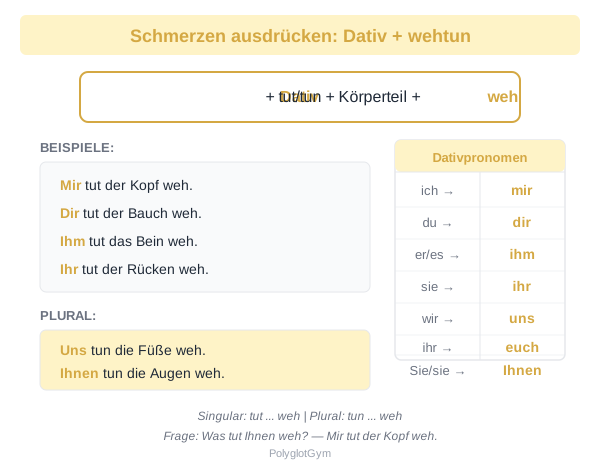
Learners say Mein Kopf tut weh (possessive) instead of Mir tut der Kopf weh (dative). German uses the dative pronoun, not the possessive.
🇬🇧 English speakers: English speakers use possessives: 'Mein Kopf tut weh' instead of 'Mir tut der Kopf weh' — English always uses 'my' with body parts.
Common Error Patterns
Incorrect number word form or usage
Review number patterns and exceptions (eins as standalone vs ein before nouns)
Wrong time expression format
Review formal (14:30 Uhr) vs informal (halb drei) time expressions
Incorrect spelling based on pronunciation rules
Review German spelling conventions: ie=[iː], ei=[aɪ], ß after long vowels, ss after short vowels
Mir tut der Rücken weh.
My back hurts.
Mir (dative) + tut + body part + weh. Not: Mein Rücken tut weh.
Tut dir der Bauch weh?
Does your stomach hurt?
Dir (dative for du) + tut + der Bauch + weh.
Ihm tun die Augen weh.
His eyes hurt.
Plural body part: tun (not tut). Ihm = dative for er.
Practice in course
Apply this grammar in A1 course exercises
Frequently asked questions
- When is Dativ bei Körperteilen used?
- Im Deutschen verwendet man bei Körperteilen Dativpronomen statt Possessivartikel — anders als im Englischen.
- How is Dativ bei Körperteilen formed?
- Singular vs. Plural: Ein Körperteil: tut ... weh . Mehrere: tun ... weh : Mir tun die Füße weh. Wichtig: Mir tut der Kopf weh (nicht mein Kopf) — der Dativ zeigt den Besitzer.
- What are common mistakes with Dativ bei Körperteilen?
- Learners say Mein Kopf tut weh (possessive) instead of Mir tut der Kopf weh (dative). German uses the dative pronoun, not the possessive. 🇬🇧 English speakers: English speakers use possessives: 'Mein Kopf tut weh' instead of 'Mir tut der Kopf weh' — English always uses 'my' with body parts. 🇷🇺 Russian speakers: Russian speakers handle dative with body parts well since Russian uses a similar construction: 'У меня болит голова' (at me hurts head). 🇨🇿 Czech speakers: Czech speakers handle this well since Czech uses a similar dative construction: 'Bolí mě hlava' — the possessive-free pattern transfers naturally.