VerbiA2
Budoucí čas dokonavých sloves
Perfective present forms express the future (udělám, koupím, napíšu); budu + infinitive is only for imperfectives
Obiettivo di apprendimento
I can form the future correctly for both aspects: budu + infinitive for imperfectives, present forms for perfectives.
Competenze d'esame:CCE A2 · ScritturaCCE A2 · Conversazione
Guarda questi esempi. Riesci a individuare lo schema grammaticale?
Zítra koupím lístky na vlak do Olomouce.
Tomorrow I will buy train tickets to Olomouc.
O víkendu budu číst a v neděli večer ti zavolám.
At the weekend I will be reading, and on Sunday evening I will call you.
Až přijedeš do Prahy, ukážu ti Vyšehrad.
When you come to Prague, I will show you Vyšehrad.
Presta attenzione alle parti evidenziate. Cosa hanno in comune?
A perfective verb has no "now". Put it into the present-tense endings you already know from dělám, píšu, kupuju, and the action moves into the future: udělám "I'll do it", napíšu "I'll write it", koupím "I'll buy it". Imperfectives build their future with budu; perfectives do not, so *budu koupit and *budu udělat are not Czech.
| Imperfective present | Imperfective future | Perfective future |
|---|---|---|
| dělám (I'm doing, I do) | budu dělat | udělám |
| píšu | budu psát | napíšu |
| volám | budu volat | zavolám |
| čtu | budu číst | přečtu |
| učím se | budu se učit | naučím se |
"Will" does not decide, aspect does
English has will, going to and "I'm meeting her tomorrow", and none of them tells you which Czech form to use. Ask whether you promise a finished act or describe an activity: Zítra napíšu tu zprávu (I'll get the report written) against Zítra budu psát zprávu (I'll be working on it, finished or not). Večer ti zavolám is one call; Budu ti volat každý den is a promise of many.
"Right away" is still the future
Because the form looks like a present, English speakers hear Hned vám přinesu jídelní lístek as "I'm bringing you the menu". It is what the waiter says before he goes to get it: "I'll bring it right away". Počkej, hned to bude - hang on, it'll be ready in a second.
Až: when, in the future
After "when" and "if", English switches to the present: "when you come", "if it rains". Czech keeps the future, and for a future "when" it uses až: Až přijedeš do Prahy, ukážu ti Vyšehrad. Až dodělám diplomku, pojedu na měsíc do Chorvatska. The English habit produces Až máš čas; Czech says Až budeš mít čas, zavolej. For "if" the same applies: Jestli bude pršet, zůstaneme doma. Když with the present means "whenever": Když prší, chodíme do kina.
When the perfective present is not future
The form has two other jobs worth recognising. It describes something that happens again and again, each time as a whole: Vždycky přijde pozdě. (He always turns up late.) Proverbs use it the same way: Kdo dřív přijde, ten dřív mele, first come, first served. And with ne- it often means "won't manage": To do pátku nestihnu. (I won't get it done by Friday.)
Applica questa grammatica negli esercizi del corso A2
Esercizi di pratica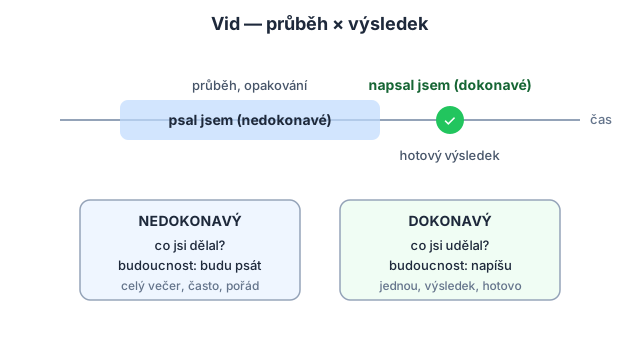
- The classic: *budu koupit → koupím; *budu udělat → udělám
- Reading udělám as present: it points to the future (or to a repeated whole act: Vždycky přijde pozdě), never to right now
- Aspect misidentified: budu psát (will be writing) vs napíšu (will write and finish)
Zítra koupím lístky na vlak do Olomouce.
Tomorrow I will buy train tickets to Olomouc.
koupím: perfective present form = future, no budu.
O víkendu budu číst a v neděli večer ti zavolám.
At the weekend I will be reading, and on Sunday evening I will call you.
Both futures side by side: budu číst (imperf.) + zavolám (perf.).
Až přijedeš do Prahy, ukážu ti Vyšehrad.
When you come to Prague, I will show you Vyšehrad.
až + perfective future in time clauses about the future.
La verifica per questo argomento è ancora in preparazione
Chiedi a Sofi
Pratica nel corso
Applica questa grammatica negli esercizi del corso A2