Động từB1
Präteritum regelmäßige Verben
Simple past tense formation for regular (weak) verbs
Mục tiêu học tập
Can narrate past events using regular simple past forms
Kỹ năng thi cử:ĐọcViết
Hãy xem các ví dụ sau. Bạn có nhận ra quy tắc ngữ pháp không?
Sie machte die Tür auf.
She opened the door.
Wir reisten nach Spanien.
We traveled to Spain.
Er arbeitete den ganzen Tag.
He worked all day.
Die Kinder spielten im Garten.
The children played in the garden.
Chú ý các phần được đánh dấu. Chúng có điểm gì chung?
At A2 you learned Präteritum of sein, haben, and modals. Now we extend to all regular verbs — essential for written narratives.
Formation: stem + -te + personal ending.
| machen | arbeiten | reisen | |
|---|---|---|---|
| ich | machte | arbeitete | reiste |
| du | machtest | arbeitetest | reistest |
| er/sie/es | machte | arbeitete | reiste |
| wir | machten | arbeiteten | reisten |
| ihr | machtet | arbeitetet | reistet |
| sie/Sie | machten | arbeiteten | reisten |
Stems ending in -t, -d, -chn, -ffn insert extra -e-: arbeitete, öffnete.
Usage: Written texts prefer Präteritum. Spoken German prefers Perfekt except for sein/haben/modals.
Áp dụng ngữ pháp này vào các bài tập khóa học B1
Bài tập thực hành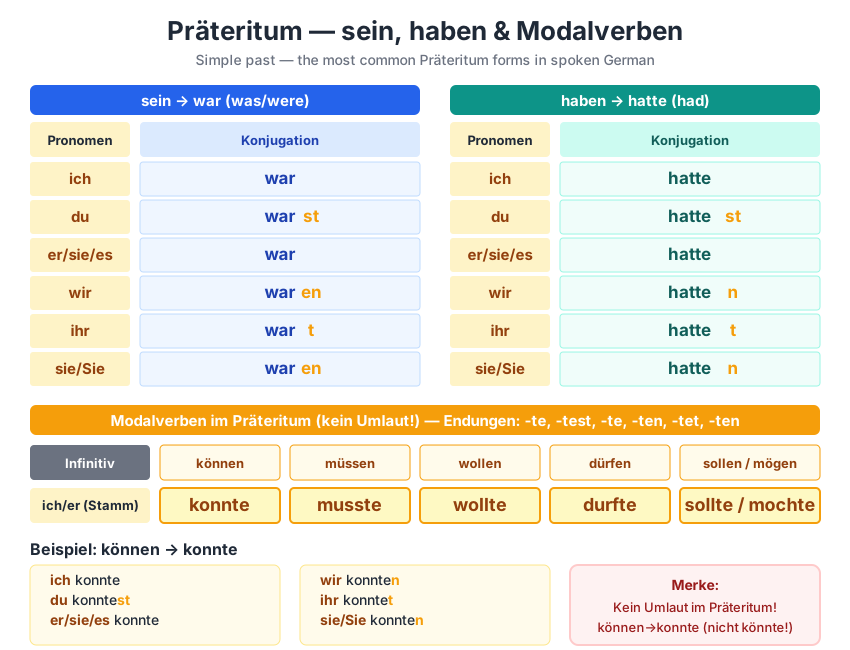
- Forgetting -te: Always include the -te marker for regular verbs.
- Missing buffer -e-: Stems ending in -t need it: arbeitete.
- Using Präteritum in speech: Sounds literary. Use Perfekt in conversation.
Các lỗi thường gặp
Incorrect verb ending for the subject
Review verb conjugation tables and practice matching endings to pronouns
Forgot stem vowel change in irregular verbs
Practice stem-changing verbs (e→i, e→ie, a→ä) with flashcards
Verb placed in wrong position
Remember: V2 in main clauses, verb-final in subordinate clauses
Sie machte die Tür auf.
She opened the door.
Machte = Präteritum of machen.
Wir reisten nach Spanien.
We traveled to Spain.
Reisten = Präteritum of reisen.
Er arbeitete den ganzen Tag.
He worked all day.
Arbeitete: stem -t, extra -e- inserted.
Die Kinder spielten im Garten.
The children played in the garden.
Spielten = standard regular Präteritum.
Luyện tập trong khóa học
Áp dụng ngữ pháp này vào các bài tập khóa học B1