Động từB1
Konjunktiv II (Grundformen)
Subjunctive II for polite requests, wishes, and unreal conditions
Mục tiêu học tập
Can make polite requests and express wishes with Konj. II
Kỹ năng thi cử:ViếtNói
Hãy xem các ví dụ sau. Bạn có nhận ra quy tắc ngữ pháp không?
Könnten Sie mir bitte helfen?
Could you please help me?
Ich hätte gern ein Glas Wasser.
I would like a glass of water.
Wenn ich reich wäre, würde ich reisen.
If I were rich, I would travel.
Du solltest mehr Gemüse essen.
You should eat more vegetables.
Chú ý các phần được đánh dấu. Chúng có điểm gì chung?
Konjunktiv II expresses wishes, hypothetical situations, polite requests.
| sein | haben | können | müssen | dürfen | |
|---|---|---|---|---|---|
| ich | wäre | hätte | könnte | müsste | dürfte |
| du | wärst | hättest | könntest | müsstest | dürftest |
| er/sie/es | wäre | hätte | könnte | müsste | dürfte |
| wir | wären | hätten | könnten | müssten | dürften |
| ihr | wärt | hättet | könntet | müsstet | dürftet |
| sie/Sie | wären | hätten | könnten | müssten | dürften |
Formation: Präteritum stem + umlaut + endings (-e, -est, -e, -en, -et, -en).
Uses: Polite (Könnten Sie mir helfen?), wishes (Ich hätte gern...), advice (Du solltest...), unreal conditions (Wenn ich Zeit hätte...).
Áp dụng ngữ pháp này vào các bài tập khóa học B1
Bài tập thực hành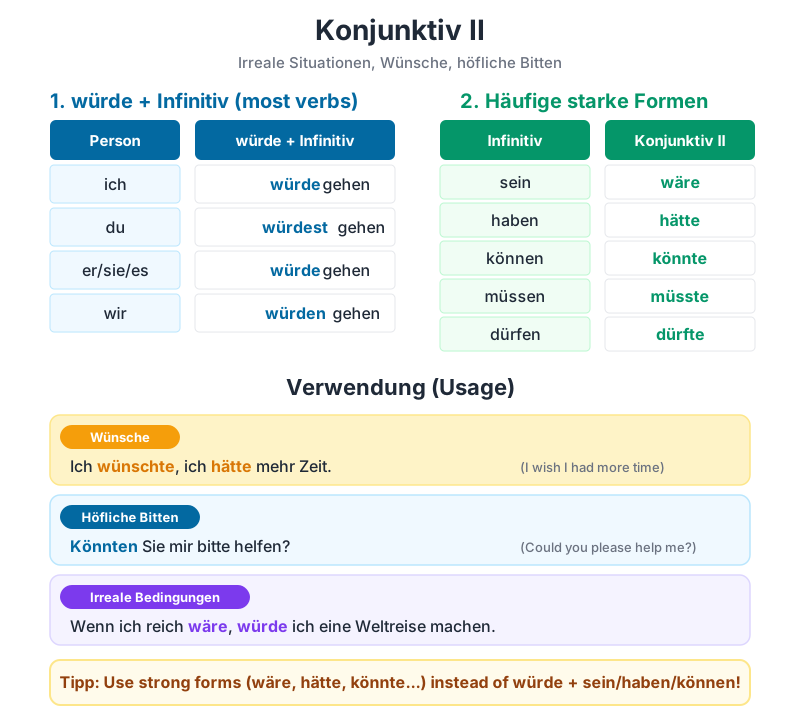
- Präteritum vs. Konjunktiv: konnte (past fact) vs. könnte (hypothetical). Umlaut makes the difference!
- Overusing basic forms: For most verbs, use würde + Infinitiv. Only sein/haben/modals commonly use own forms.
- Forgetting umlaut: ✗ ich ware → ✓ ich wäre.
Các lỗi thường gặp
Incorrect verb ending for the subject
Review verb conjugation tables and practice matching endings to pronouns
Forgot stem vowel change in irregular verbs
Practice stem-changing verbs (e→i, e→ie, a→ä) with flashcards
Verb placed in wrong position
Remember: V2 in main clauses, verb-final in subordinate clauses
Könnten Sie mir bitte helfen?
Could you please help me?
Polite request with könnten.
Ich hätte gern ein Glas Wasser.
I would like a glass of water.
Hätte gern = polite request.
Wenn ich reich wäre, würde ich reisen.
If I were rich, I would travel.
Wäre in wenn-clause (unreal condition).
Du solltest mehr Gemüse essen.
You should eat more vegetables.
Solltest = Konj. II of sollen. Friendly advice.
An deiner Stelle würde ich das nicht machen.
In your place, I wouldn't do that.
Hypothetical advice with würde.
Luyện tập trong khóa học
Áp dụng ngữ pháp này vào các bài tập khóa học B1