句子结构A1
Nebensatz mit 'weil'
Subordinate clauses with weil — verb goes to end
学习目标
Can give reasons using weil with verb-final order
考试技能:阅读写作口语
观察以下示例,你能发现语法规律吗?
Ich lerne Deutsch, weil ich in Berlin arbeite.
I am learning German because I work in Berlin.
Weil das Wetter schön ist, gehen wir spazieren.
Because the weather is nice, we are going for a walk.
Er kommt nicht, weil er keine Zeit hat.
He is not coming because he has no time.
注意高亮部分,它们有什么共同点?
Weil means "because". It also gives you your first taste of a core German rule: in a subordinate clause, the conjugated verb goes to the end.
| Main clause | weil clause | English |
|---|---|---|
| Ich bleibe zu Hause, | weil ich krank bin. | I'm staying at home because I'm ill. |
| Er lernt Deutsch, | weil er in Berlin arbeitet. | He's learning German because he works in Berlin. |
| Sie kommt nicht, | weil sie keine Zeit hat. | She isn't coming because she has no time. |
English keeps its normal order after "because": "because I am ill". Carried over, that gives *weil ich bin krank, which is what English habits produce. Picture weil and the verb as two ends of a bracket, with everything else inside.
Longer verb groups
If there is a modal or a separable verb, the conjugated part still goes last:
| German | English |
|---|---|
| ..., weil ich morgen arbeiten muss. | ... because I have to work tomorrow. |
| ..., weil ich um sechs aufstehe. | ... because I get up at six. |
The separable verb joins back together: aufstehe, not *stehe auf.
When the weil clause comes first
The whole weil clause then counts as position 1, so the main-clause verb comes right after the comma, before the subject: Weil das Wetter schön ist, gehen wir spazieren. - Because the weather is nice, we're going for a walk.
The comma
German sets subordinate clauses off with a comma, so a weil clause that follows a main clause always has a comma before it. English often has none before "because", which is why the comma is easy to forget in writing.
weil or denn?
Both mean "because"; the difference is the word order:
| Conjunction | Example | Verb position |
|---|---|---|
| weil | ..., weil ich müde bin. | at the end |
| denn | ..., denn ich bin müde. | normal position 2 |
In relaxed speech you will hear Germans say weil ich bin müde too, with a little pause after weil. That is a feature of spoken German, not of the standard; in writing and in exams, put the verb at the end.
在 A1 课程练习中应用此语法
练习题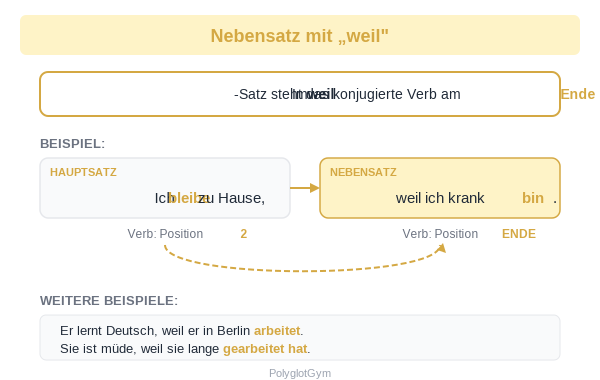
Learners keep normal word order after weil: weil ich bin krank instead of weil ich krank bin. The verb must go to the end.
🇬🇧 English speakers: English speakers keep V2 word order after 'weil': 'weil ich bin krank' instead of 'weil ich krank bin' — English 'because' doesn't change word order.
Ich lerne Deutsch, weil ich in Berlin arbeite.
I am learning German because I work in Berlin.
After weil, the verb arbeite goes to the end of the clause.
Weil das Wetter schön ist, gehen wir spazieren.
Because the weather is nice, we are going for a walk.
Weil-clause first: verb ist at the end. Main clause: verb gehen right after comma.
Er kommt nicht, weil er keine Zeit hat.
He is not coming because he has no time.
Hat goes to the end of the weil-clause.
这个主题的检测还在准备中
问问索菲
在课程中练习
在 A1 课程练习中应用此语法