冠词A1
Possessivartikel
Possessive articles mein/dein/sein/ihr
学习目标
Can express possession using possessive articles
考试技能:阅读写作口语
观察以下示例,你能发现语法规律吗?
Das ist mein Buch.
That is my book.
Wo ist deine Tasche?
Where is your bag?
Seine Kinder sind noch klein.
His children are still small.
注意高亮部分,它们有什么共同点?
Possessive words like "my", "your" and "his" go in front of a noun in German too. Two things are new for an English speaker: they take endings like the article ein, and ihr has three meanings.
| Person | Possessive | Person | Possessive |
|---|---|---|---|
| ich | mein - my | wir | unser - our |
| du | dein - your | ihr | euer - your (pl.) |
| er / es | sein - his / its | sie (they) | ihr - their |
| sie (she) | ihr - her | Sie (formal) | Ihr - your |
Whose is it? Look at the owner
Like English, German chooses the possessive by the owner: Peter und seine Mutter (his), Lisa und ihre Mutter (her). Ihr means "her", "their", or, with a capital, polite "your". Context sorts it out: Frau Weber, ist das Ihr Schirm? - Mrs Weber, is that your umbrella?
Endings: look at the noun
Here German differs from English. The ending depends on the gender, number and case of the thing owned, exactly as with ein and kein:
| Masculine | Feminine | Neuter | Plural | |
|---|---|---|---|---|
| Nominative (subject) | mein | meine | mein | meine |
| Accusative (object) | meinen | meine | mein | meine |
So: Das ist mein Bruder (der Bruder, subject). Das ist meine Schwester (die Schwester). Ich besuche meinen Bruder (object, masculine). A woman talking about her husband says mein Mann; the ending has nothing to do with her being female.
A typical English-speaker error is *Ich kenne ihr Mann for "I know her husband". Mann is a masculine object, so the correct form is Ich kenne ihren Mann. The owner chooses the word (ihr), the noun chooses the ending (-en).
unser and euer
Euer loses its second e when an ending is added: eure Wohnung, euren Hund. Unser keeps it: unsere Kinder, unseren Garten. Unsere Oma backt jedes Jahr Weihnachtsplätzchen.
在 A1 课程练习中应用此语法
练习题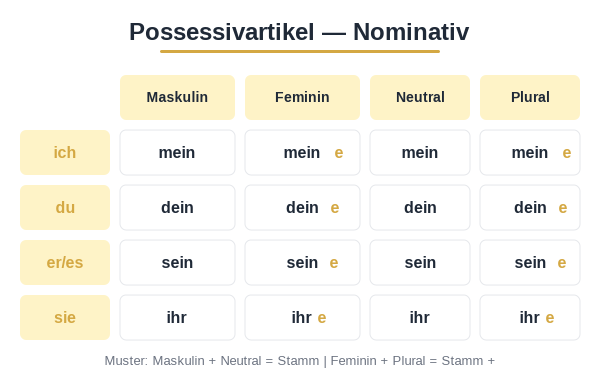
Learners mix up sein (his) and ihr (her), or forget to decline: mein Schwester instead of meine Schwester.
🇬🇧 English speakers: English speakers forget to decline possessives: 'mein Schwester' instead of 'meine Schwester' — English 'my' never changes form.
Das ist mein Buch.
That is my book.
Buch is neuter (das) — mein has no ending in nominative neuter.
Wo ist deine Tasche?
Where is your bag?
Tasche is feminine (die) — dein gets -e ending: deine.
Seine Kinder sind noch klein.
His children are still small.
Plural uses -e ending: seine Kinder (like die → keine → seine).
这个主题的检测还在准备中
问问索菲
在课程中练习
在 A1 课程练习中应用此语法