VerbsC1
Indirekte Rede der Presse
Journalistic Konjunktiv I in full: backshift-free reporting, würde/Konjunktiv II as replacement when forms collide, tense layers (sei gewesen)
Learning Goal
I can report in journalistic Konjunktiv I with the full replacement cascade.
Exam Skills:ReadingWriting
Look at these examples. Can you spot the grammar pattern?
Der Trainer erklärte, die Mannschaft sei müde, aber man werde am Sonntag dennoch gewinnen.
The coach explained that the team was tired but that they would still win on Sunday.
Die Anwohner sagten, sie hätten den Lärm seit Wochen gemeldet, doch niemand habe reagiert.
The residents said they had been reporting the noise for weeks, but nobody had responded.
Pay attention to the highlighted parts. What do they have in common?
Das Pressesystem:
| Original | Indirekte Rede |
|---|---|
| „Ich bin zufrieden." | Sie sagte, sie sei zufrieden. |
| „Wir haben Zeit." | Sie sagten, sie hätten Zeit. (haben = Indikativ → K II!) |
| „Ich war dort." | Er sagte, er sei dort gewesen. |
| „Wir werden prüfen." | Man werde prüfen. |
Ersatzregel: Fällt Konjunktiv I mit dem Indikativ zusammen (sie haben), springt Konjunktiv II ein (sie hätten); klingt der zu gestelzt - würde-Form. Der Konjunktiv signalisiert Distanz OHNE Zweifel - das deutsche Presseprivileg: keine Anführungszeichen nötig, Seiten ohne ein einziges Komma der Übernahme.
Apply this grammar in C1 course exercises
Practice Exercises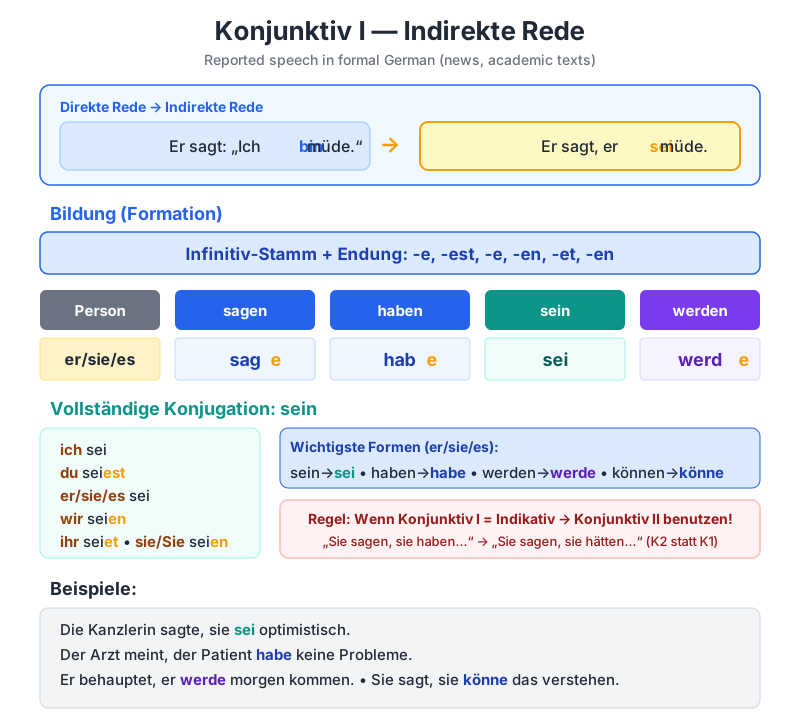
- Indicative in reported speech: drops the distance signal
- K I kept where it equals indicative: sie haben → sie hätten
Common Error Patterns
Indicative in press reports
K I marks reported speech
K I = indicative left unfixed
Collision → K II → würde
Der Trainer erklärte, die Mannschaft sei müde, aber man werde am Sonntag dennoch gewinnen.
The coach explained that the team was tired but that they would still win on Sunday.
sei + werde: present and future reported.
Die Anwohner sagten, sie hätten den Lärm seit Wochen gemeldet, doch niemand habe reagiert.
The residents said they had been reporting the noise for weeks, but nobody had responded.
hätten (collision fix) + habe reagiert (K I past).
Practice in course
Apply this grammar in C1 course exercises
Frequently asked questions
- When is Indirekte Rede der Presse used?
- Ersatzregel: Fällt Konjunktiv I mit dem Indikativ zusammen (sie haben), springt Konjunktiv II ein (sie hätten); klingt der zu gestelzt - würde-Form. Der Konjunktiv signalisiert Distanz OHNE Zweifel - das deutsche Presseprivileg: keine Anführungszeichen nötig, Seiten ohne ein einziges Komma der Übernahme.
- What are common mistakes with Indirekte Rede der Presse?
- Indicative in reported speech: drops the distance signal K I kept where it equals indicative: sie haben → sie hätten