VerbsB2
Konjunktiv I (indirekte Rede)
Konjunktiv I for reported speech in formal German
Learning Goal
Can report speech formally using Konjunktiv I
Exam Skills:ReadingWriting
Look at these examples. Can you spot the grammar pattern?
Der Präsident sagte, er sei zuversichtlich.
The president said he was confident.
Die Zeitung berichtet, es gebe keine Probleme.
The newspaper reports there are no problems.
Er sagte, er habe davon nichts gewusst.
He said he had known nothing about it.
Sie behauptete, sie könne alles erklären.
She claimed she could explain everything.
Pay attention to the highlighted parts. What do they have in common?
Konjunktiv I is used in formal reported speech (newspapers, academic texts) to signal that the speaker is quoting someone else.
| sein | haben | können | machen | |
|---|---|---|---|---|
| er/sie/es | sei | habe | könne | mache |
| sie (Pl.) | seien | hätten* | könnten* | machten* |
*When Konj. I = indicative, use Konj. II instead.
Formation: Infinitive stem + -e, -est, -e, -en, -et, -en. Most useful: 3rd person singular (er mache, sie habe, er könne).
Usage: Der Minister sagte, die Lage sei ernst. Compare: Der Minister sagte, dass die Lage ernst ist (indicative, more informal).
Past reported speech: Er sagte, er habe das nicht gewusst.
Apply this grammar in B2 course exercises
Practice Exercises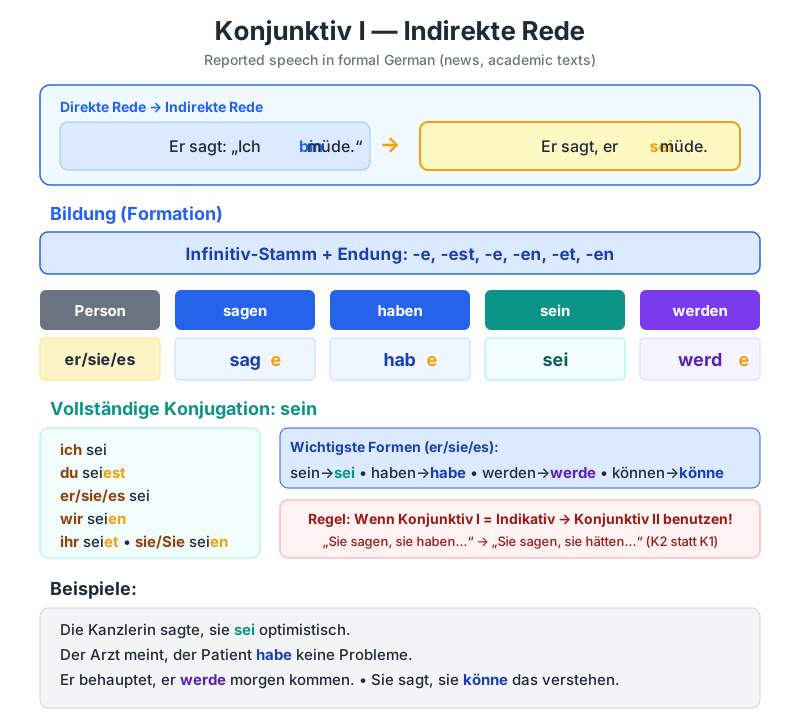
- Using Konj. I in speech: Sounds very formal. In conversation, use indicative or dass-clauses.
- Identical to indicative: When Konj. I = indicative (ich mache = ich mache), switch to Konj. II.
- Confusing Konj. I and II: Konj. I = reported speech; Konj. II = hypothetical/unreal.
Common Error Patterns
Incorrect verb ending for the subject
Review verb conjugation tables and practice matching endings to pronouns
Forgot stem vowel change in irregular verbs
Practice stem-changing verbs (e→i, e→ie, a→ä) with flashcards
Verb placed in wrong position
Remember: V2 in main clauses, verb-final in subordinate clauses
Der Präsident sagte, er sei zuversichtlich.
The president said he was confident.
Sei = Konj. I of sein. Signals reported speech.
Die Zeitung berichtet, es gebe keine Probleme.
The newspaper reports there are no problems.
Gebe = Konj. I of geben. Formal reporting.
Er sagte, er habe davon nichts gewusst.
He said he had known nothing about it.
Habe + Partizip II = past Konj. I.
Sie behauptete, sie könne alles erklären.
She claimed she could explain everything.
Könne = Konj. I of können.
Practice in course
Apply this grammar in B2 course exercises
Frequently asked questions
- When is Konjunktiv I (indirekte Rede) used?
- Konjunktiv I is used in formal reported speech (newspapers, academic texts) to signal that the speaker is quoting someone else.
- How is Konjunktiv I (indirekte Rede) formed?
- Formation: Infinitive stem + -e, -est, -e, -en, -et, -en. Most useful: 3rd person singular ( er mache, sie habe, er könne ). Usage: Der Minister sagte , die Lage sei ernst . Compare: Der Minister sagte, dass die Lage ernst ist (indicative, more informal).
- What are common mistakes with Konjunktiv I (indirekte Rede)?
- Using Konj. I in speech: Sounds very formal. In conversation, use indicative or dass-clauses. Identical to indicative: When Konj. I = indicative (ich mache = ich mache), switch to Konj. II. Confusing Konj. I and II: Konj. I = reported speech; Konj. II = hypothetical/unreal.