OtherA1
Numbers 0 to 10
Numbers from zero to ten
Learning Goal
Can understand and use numbers in everyday situations
Exam Skills:ListeningSpeaking
Look at these examples. Can you spot the grammar pattern?
Meine Telefonnummer ist null-drei-eins-fünf.
My phone number is 0-3-1-5.
Ich habe zwei Kinder.
I have two children.
Das kostet sieben Euro.
That costs seven euros.
Pay attention to the highlighted parts. What do they have in common?
The numbers from zero to ten are the building blocks of every German number, and several of them look like their English cousins: drei and three, acht and eight, neun and nine.
| Number | German | Number | German |
|---|---|---|---|
| 0 | null | 6 | sechs |
| 1 | eins | 7 | sieben |
| 2 | zwei | 8 | acht |
| 3 | drei | 9 | neun |
| 4 | vier | 10 | zehn |
| 5 | fünf |
Pronunciation traps
Zwei and zehn start with "ts", not "z": "tsvy", "tsayn". Vier starts with an f-sound, like "fear". Sechs sounds like "zecks", and neun rhymes with "coin" with an n in front. In fünf, round your lips for the ü; "funf" is the English-speaker version Germans notice at once.
zwei or zwo?
On the phone, at a train station or in the army you will hear zwo instead of zwei. It exists because zwei and drei are easy to confuse on a bad line. Deutsche Bahn announcements say Gleis zwo (platform two), and a Berliner might read out a phone number as null-drei-null, zwo-fünf-sieben.
eins, ein, eine
When you count or give a number on its own, you say eins: eins, zwei, drei; Wie viele Brötchen? - Eins. Referring back to a noun, the number follows the noun's gender: Wie viele Brezeln? - Eine. Before a noun, "one" turns into the article ein or eine, depending on the noun's gender: ein Brötchen, eine Brezel. English uses "a" and "one" for two different jobs; German uses one word for both, so Ich habe ein Kind can mean "a child" or "one child". Stress ein to make it "one".
Apply this grammar in A1 course exercises
Practice Exercises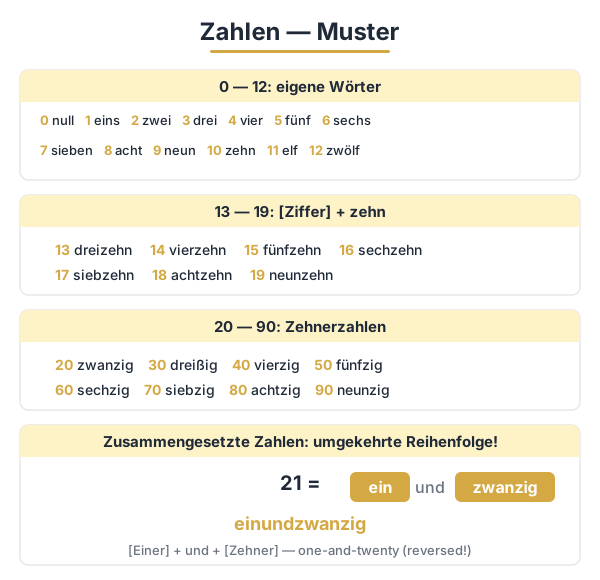
Learners mix up vier (4) and für (for), or drei (3) and zwei (2) because they rhyme.
🇬🇧 English speakers: English speakers confuse zwei/drei due to rhyming, and may pronounce sechs like English 'sex' instead of [zɛks].
Common Error Patterns
Incorrect number word form or usage
Review number patterns and exceptions (eins as standalone vs ein before nouns)
Meine Telefonnummer ist null-drei-eins-fünf.
My phone number is 0-3-1-5.
Phone numbers are read digit by digit in German.
Ich habe zwei Kinder.
I have two children.
Zwei (two) is used as a normal number before nouns.
Das kostet sieben Euro.
That costs seven euros.
Euro stays singular in German even after numbers: sieben Euro, not Euros.
The check for this topic is still being prepared
Ask Sofi
Ready-made hints are free
Practice in course
Apply this grammar in A1 course exercises
Frequently asked questions
- When do you use Numbers 0 to 10?
- The numbers from zero to ten are the building blocks of every German number, and several of them look like their English cousins: drei and three, acht and eight, neun and nine.
- How do you form Numbers 0 to 10?
- Zwei and zehn start with "ts", not "z": "tsvy", "tsayn". Vier starts with an f-sound, like "fear". Sechs sounds like "zecks", and neun rhymes with "coin" with an n in front. In fünf , round your lips for the ü; "funf" is the English-speaker version Germans notice at once. On the phone, at a train station or in the army you will hear zwo instead of zwei . It exists because zwei and drei are easy to confuse on a bad line. Deutsche Bahn announcements say Gleis zwo (platform two), and a Berliner might read out a phone number as null-drei-null, zwo-fünf-sieben . When you count or give a number on its own, you say eins : eins, zwei, drei ; Wie viele Brötchen? - Eins.
- What are common mistakes with Numbers 0 to 10?
- Learners mix up vier (4) and für (for), or drei (3) and zwei (2) because they rhyme. 🇬🇧 English speakers: English speakers confuse zwei/drei due to rhyming, and may pronounce sechs like English 'sex' instead of [zɛks].