SlovesaB1
Préteritum nepravidelných sloves
Simple past of irregular (strong) verbs with stem vowel changes
Cíl učení
Can use irregular simple past forms in written narratives
Zkouškové dovednosti:ČteníPsaní
Podívejte se na tyto příklady. Dokážete rozpoznat gramatický vzorec?
Er ging um acht Uhr aus dem Haus.
He left the house at eight.
Sie schrieb einen langen Brief.
She wrote a long letter.
Wir fanden den Schlüssel.
We found the key.
Die Lehrerin sprach langsam.
The teacher spoke slowly.
Zaměřte se na zvýrazněné části. Co mají společného?
Irregular verbs change their stem vowel and do not add -te. The ich and er/sie/es forms have no ending.
| Infinitiv | Präteritum | Partizip II |
|---|---|---|
| gehen | ging | gegangen |
| kommen | kam | gekommen |
| schreiben | schrieb | geschrieben |
| sprechen | sprach | gesprochen |
| finden | fand | gefunden |
| nehmen | nahm | genommen |
| sehen | sah | gesehen |
Conjugation (gehen→ging): ich ging, du gingst, er ging, wir gingen, ihr gingt, sie gingen. Endings: —, -st, —, -en, -t, -en. Each strong verb's stem must be memorized.
Použijte tuto gramatiku ve cvičeních kurzu B1
Procvičovací cvičení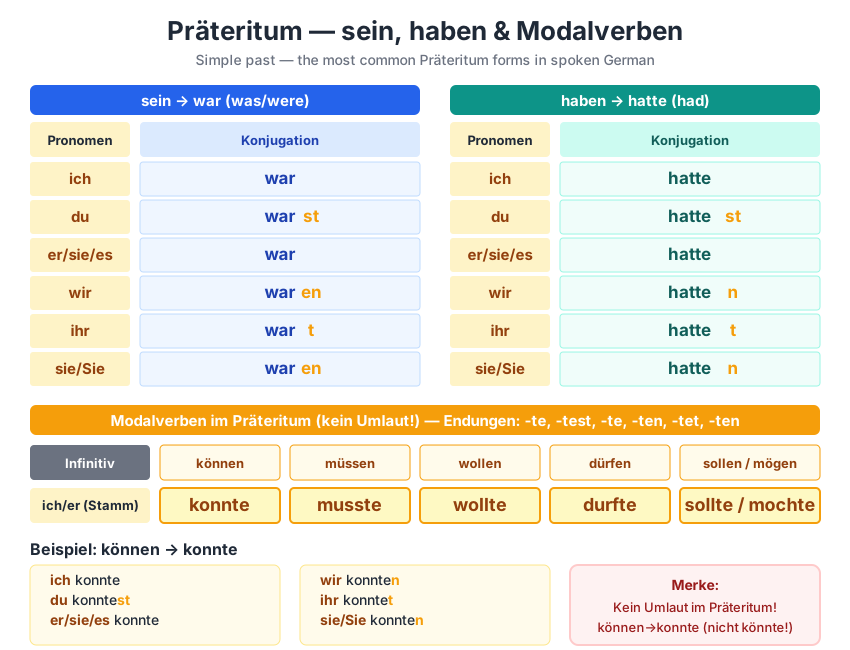
- Adding -te: ✗ er gehte → ✓ er ging.
- Adding -e to ich/er: ✗ ich ginge (= Konjunktiv!) → ✓ ich ging.
- Guessing the vowel: geben→gab but leben→lebte (regular!). Must learn which are strong.
Časté chyby
Incorrect verb ending for the subject
Review verb conjugation tables and practice matching endings to pronouns
Forgot stem vowel change in irregular verbs
Practice stem-changing verbs (e→i, e→ie, a→ä) with flashcards
Verb placed in wrong position
Remember: V2 in main clauses, verb-final in subordinate clauses
Er ging um acht Uhr aus dem Haus.
He left the house at eight.
Gehen → ging. No ending for er.
Sie schrieb einen langen Brief.
She wrote a long letter.
Schreiben → schrieb. Vowel ei→ie.
Wir fanden den Schlüssel.
We found the key.
Finden → fand, wir fanden.
Die Lehrerin sprach langsam.
The teacher spoke slowly.
Sprechen → sprach. Vowel e→a.
Procvičit v kurzu
Použijte tuto gramatiku ve cvičeních kurzu B1