Wortstellung mit Zeitangaben
Word order when time expressions come first
Can place time expressions correctly in sentences
Look at these examples. Can you spot the grammar pattern?
Morgen fahre ich nach Hamburg.
Tomorrow I am going to Hamburg.
Am Wochenende besuche ich meine Eltern.
On the weekend I visit my parents.
Um 8 Uhr beginnt der Unterricht.
At 8 o'clock the class begins.
Pay attention to the highlighted parts. What do they have in common?
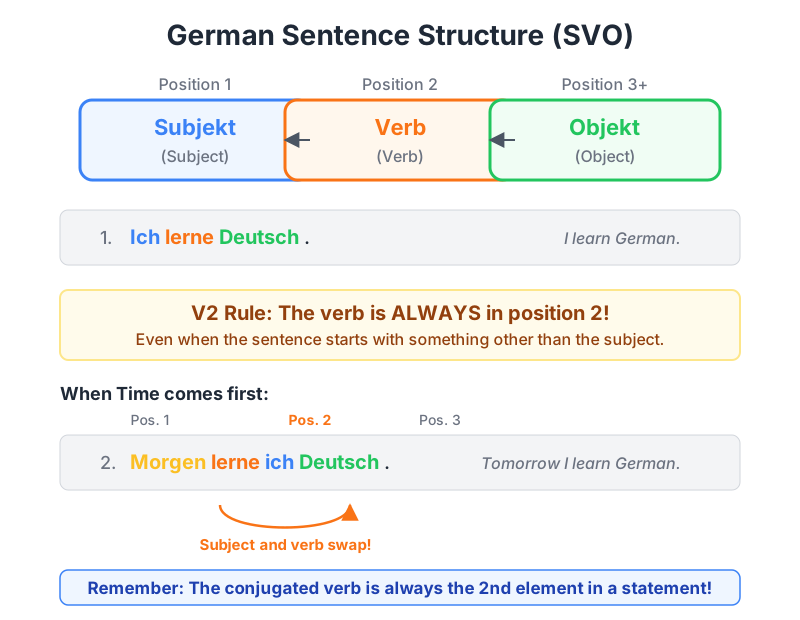
Im deutschen Hauptsatz steht das Verb immer an Position 2. Wenn ein anderes Element den Satz beginnt, rückt das Subjekt nach hinten.
Inversion bei vorangestelltem Zeitelement:
| Position 1 | Position 2 (Verb) | Position 3 | Rest |
|---|---|---|---|
| Ich | gehe | heute | ins Kino. |
| Heute | gehe | ich | ins Kino. |
| Am Montag | habe | ich | Deutschkurs. |
Regel: Das Verb bleibt immer an Position 2. Wenn Position 1 nicht das Subjekt ist, tauschen Subjekt und Verb: Morgen kommt er.
Tipp: Diese Inversion gilt für jedes vorangestellte Element, nicht nur Zeit: In Berlin wohne ich. Deutsch lerne ich gern.
Common Error Patterns
Wrong order of time, manner, place elements
German order: TEMPORAL → MODAL → LOKAL (when → how → where). Ich fahre morgen schnell nach Berlin
Placed adverb before conjugated verb
If time expression is first, verb still second: Morgen GEHE ich... (not: Morgen ich gehe)
Verb not in second position after fronted element
V2 rule applies even when sentence starts with time: Gestern WAR ich krank (not: Gestern ich war krank)
Morgen fahre ich nach Hamburg.
Tomorrow I am going to Hamburg.
Morgen at position 1, verb fahre at position 2, subject ich at position 3.
Am Wochenende besuche ich meine Eltern.
On the weekend I visit my parents.
Am Wochenende is at position 1, the verb stays at position 2.
Um 8 Uhr beginnt der Unterricht.
At 8 o'clock the class begins.
Time expression first, verb second, subject third — always.
Prerequisites
Also in Sentence Structure
Practice in course
Apply this grammar in A1 course exercises