Sentence structureB2
Clitic clusters
Mastering long clitic chains: bych + se/si + dative + accusative + adverbial clitics (Já bych se mu ho bál dát)
Learning Goal
I can build clauses with three or more clitics in the canonical order, in main and subordinate clauses.
Exam Skills:CCE B2 · ReadingCCE B2 · Writing
Look at these examples. Can you spot the grammar pattern?
Vzpomněl jsem si na to až ve vlaku.
I remembered it only on the train.
Slíbil, že by nám ho tam zítra mohl přivézt.
He promised he could bring it to us there tomorrow.
Pay attention to the highlighted parts. What do they have in common?
English pronouns go where the verb puts them: I would give it to him. Czech has a set of short, unstressed words that ignore the verb and queue up in one place, right after the first item of the clause. You already know this "second position" from jsem and se. At B2 the challenge is the queue itself: one clause can carry four of these words, and their order is not up to you.
The order inside the cluster
| Slot | Words |
|---|---|
| 1. auxiliary | jsem, jsi, jsme, jste; bych, bys, by, bychom, byste |
| 2. reflexive | se, si |
| 3. dative pronoun | mi, ti, mu, nám, vám, jim |
| 4. accusative or genitive pronoun | mě, tě, ho, ji, to, je |
Včera jsem se mu to snažil vysvětlit. "Yesterday I tried to explain it to him." Learn the bold part as one block: auxiliary, reflexive, dative, accusative. Short adverbs such as tam, tu or už are not clitics (they can be stressed and can open a sentence: Tam jsem nebyl), but in practice they usually trail the cluster: Slíbil, že by nám ho tam zítra mohl přivézt.
What counts as "first"
The first slot holds a whole phrase, not one word: Můj starší bratr se mi včera ozval. After a conjunction or a relative word (že, když, protože, který, kde) the cluster follows immediately: Myslím, že bych se ho na to zeptal. Every clause builds its own cluster, so a pronoun from the main clause does not wander across the comma.
Fusions you have to know
- Aby and kdyby already contain the conditional auxiliary: abych, abys, abychom, abyste. The rest of the cluster follows straight after: Chci, abyste se mi ozvali. Kdybys mi to řekl dřív...
- jsi + se, jsi + si contract to ses, sis: Kdy ses vrátil? Koupil sis tu chatu u Sázavy? The same in the conditional: by ses, by sis.
Pronouns that climb
Pronouns that belong to an infinitive normally climb into the main clause's cluster: Bál bych se mu ho dát, "I'd be afraid to give it to him". Mu and ho are objects of dát, yet they sit next to bych se. The same in everyday sentences: Musím ti to ukázat. Nechci ho tam pouštět.
Register
Spoken Czech keeps the order but trims the words: Já sem se mu to snažil vysvětlit (obecná sem for jsem). Very casual speech even lets a clitic open the sentence (Se ví!, "Obviously!"), which you will hear in a Prague pub but should not write.
Where English speakers slip
- Following the English order: Viděl jsem ho is right, but *Já jsem viděl ho is not: Já jsem ho viděl.
- Swapping slots: *jsem mu se → jsem se mu; *že se bych → že bych se.
- Copying English "it to him": *Dal jsem to mu → Dal jsem mu to (dative before accusative).
Apply this grammar in B2 course exercises
Practice Exercises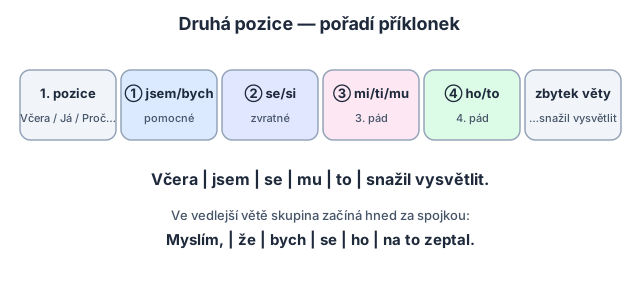
- Any deviation from ①-⑤: *že se bych → že bych se
- Splitting the cluster: *jsem mu se → jsem se mu
- Forgetting the cluster resets in each clause
Common Error Patterns
Cluster order broken with 3+ clitics
bych/jsem → se/si → dat → acc; tam/tu are full adverbs, usually right after
Vzpomněl jsem si na to až ve vlaku.
I remembered it only on the train.
jsem si: auxiliary before si.
Slíbil, že by nám ho tam zítra mohl přivézt.
He promised he could bring it to us there tomorrow.
že + by nám ho tam: four clitics right after the conjunction.
The check for this topic is still being prepared
Ask Sofi
Ready-made hints are free
Practice in course
Apply this grammar in B2 course exercises
Frequently asked questions
- When do you use Clitic clusters?
- English pronouns go where the verb puts them: I would give it to him . Czech has a set of short, unstressed words that ignore the verb and queue up in one place, right after the first item of the clause. You already know this "second position" from jsem and se . At B2 the challenge is the queue itself: one clause can carry four of these words, and their order is not up to you.
- How do you form Clitic clusters?
- Včera jsem se mu to snažil vysvětlit. "Yesterday I tried to explain it to him." Learn the bold part as one block: auxiliary, reflexive, dative, accusative. Short adverbs such as tam , tu or už are not clitics (they can be stressed and can open a sentence: Tam jsem nebyl ), but in practice they usually trail the cluster: Slíbil, že by nám ho tam zítra mohl přivézt. The first slot holds a whole phrase, not one word: Můj starší bratr se mi včera ozval . After a conjunction or a relative word ( že, když, protože, který, kde ) the cluster follows immediately: Myslím, že bych se ho na to zeptal.
- What are common mistakes with Clitic clusters?
- Any deviation from ①-⑤: *že se bych → že bych se Splitting the cluster: *jsem mu se → jsem se mu Forgetting the cluster resets in each clause