句子结构A1
'Es gibt' + Akkusativ
There is/there are with accusative
学习目标
Can describe what exists in a place using es gibt
考试技能:阅读写作口语
观察以下示例,你能发现语法规律吗?
Es gibt einen Supermarkt in der Nähe.
There is a supermarket nearby.
Gibt es hier eine Bank?
Is there a bank here?
In der Stadt gibt es viele Museen.
There are many museums in the city.
注意高亮部分,它们有什么共同点?
Es gibt is German for "there is" and "there are". Literally it means "it gives", and that literal reading explains its two quirks.
Quirk 1: it never changes for plural
English switches from "there is" to "there are". German does not: es gibt stays the same whether one thing or fifty exist, because the subject is es, not the thing.
| German | English |
|---|---|
| Es gibt einen Park. | There is a park. |
| Es gibt viele Museen. | There are lots of museums. |
There is no *es geben; the plural ending would belong to a plural subject, and es is singular.
Quirk 2: what exists is in the accusative
Since es "gives" something, that something is the direct object, so it goes into the accusative. You will see it with masculine nouns, where ein becomes einen and kein becomes keinen:
| Gender | Example | English |
|---|---|---|
| Masculine | Es gibt einen Bahnhof. | There's a station. |
| Feminine | Es gibt eine Schule. | There's a school. |
| Neuter | Es gibt ein Kino. | There's a cinema. |
| Plural | Es gibt viele Restaurants. | There are lots of restaurants. |
| Negative | Es gibt keinen Supermarkt. | There's no supermarket. |
The typical English-speaker error is *Es gibt ein Park: "there is" carries no case in English, so the article is left in the nominative.
Questions
Swap es and gibt: Gibt es hier eine Bank? - Is there a bank around here? With a question word: Was gibt es zum Mittagessen? - What's for lunch? In speech, gibt es shrinks to gibt's: Was gibt's Neues? - What's new?
在 A1 课程练习中应用此语法
练习题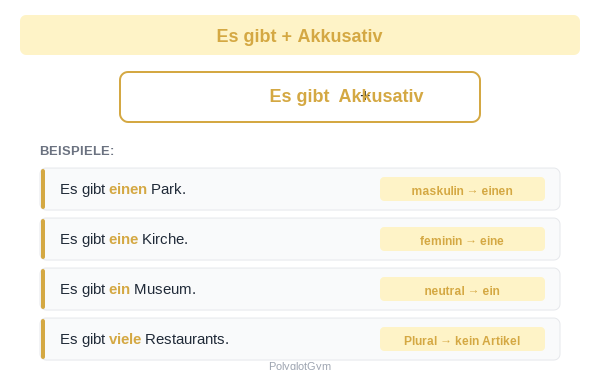
Learners use nominative after es gibt: Es gibt ein Park instead of Es gibt einen Park (accusative masculine).
🇬🇧 English speakers: English speakers use nominative after 'es gibt' since English 'there is' doesn't require case: 'Es gibt ein Park' instead of 'Es gibt einen Park'.
Es gibt einen Supermarkt in der Nähe.
There is a supermarket nearby.
Supermarkt is masculine: ein → einen (accusative).
Gibt es hier eine Bank?
Is there a bank here?
Question form: Gibt es...? Eine stays eine (feminine accusative = nominative).
In der Stadt gibt es viele Museen.
There are many museums in the city.
Es gibt works for plural too — viele Museen (accusative plural).
这个主题的检测还在准备中
问问索菲
在课程中练习
在 A1 课程练习中应用此语法