句子结构A1
Modalverb-Satzrahmen
Modal verb at position 2, infinitive at the end
学习目标
Can build sentences with modal verb and final infinitive
考试技能:阅读写作
观察以下示例,你能发现语法规律吗?
Ich muss morgen früh aufstehen.
I have to get up early tomorrow.
Du darfst hier nicht rauchen.
You are not allowed to smoke here.
Wir wollen am Samstag ins Kino gehen.
We want to go to the cinema on Saturday.
注意高亮部分,它们有什么共同点?
German likes to wrap a sentence in a bracket (Satzklammer). With a modal verb, the modal is the left side of the bracket in position 2, and the infinitive closes it at the very end. Everything else - time, objects, adverbs, nicht - goes inside.
| Position 1 | Position 2 (modal) | Middle | End (infinitive) |
|---|---|---|---|
| Ich | muss | heute viel | arbeiten. |
| Du | kannst | gut Deutsch | sprechen. |
| Wir | möchten | morgen ins Kino | gehen. |
| Er | darf | hier nicht | rauchen. |
| Am Samstag | wollen | wir auf den Viktualienmarkt | gehen. |
English keeps the two verbs together: "I must work a lot today". Carried over, that gives *Ich muss arbeiten heute, the error to watch for with modals. Think of the infinitive as the full stop of the clause: once it is said, the clause is over.
Position 1 can be anything
The last row shows that the subject does not have to come first. If a time phrase opens the sentence, the modal still stays in position 2 and the subject moves behind it: Morgen muss ich früh aufstehen.
Questions and negation
In a yes/no question the modal moves to position 1, and the infinitive still waits at the end: Kannst du mir helfen? Nicht normally sits just before the infinitive: Ich kann heute nicht kommen.
One pattern, three uses
The bracket is not special to modals; it is the backbone of German. You will see the same shape with separable verbs (Ich rufe dich morgen an) and with the perfect tense (Ich habe heute viel gearbeitet). Get comfortable with it here and two later topics become much easier.
在 A1 课程练习中应用此语法
练习题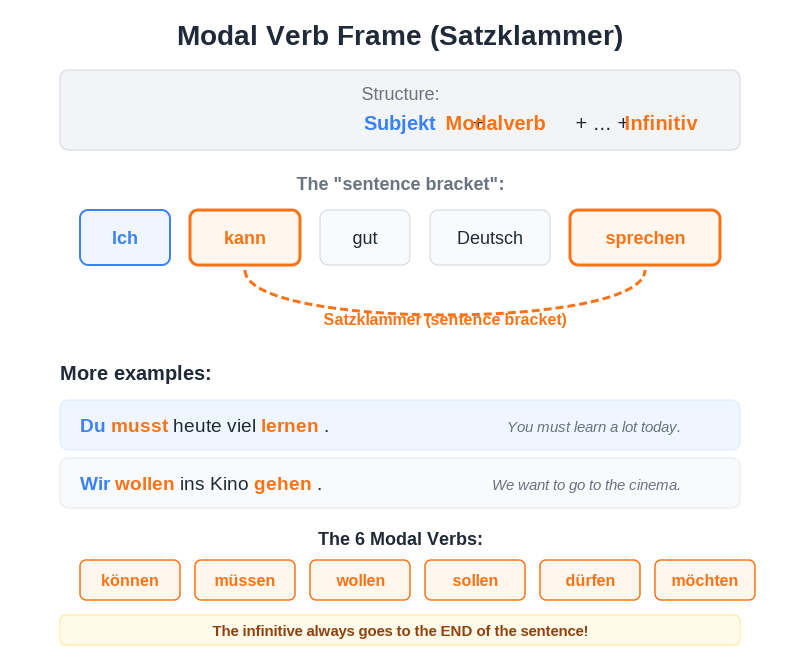
Learners put the infinitive right after the modal: Ich muss arbeiten heute instead of Ich muss heute arbeiten.
🇬🇧 English speakers: English speakers put the infinitive right after the modal (English word order): 'Ich muss arbeiten heute' instead of 'Ich muss heute arbeiten'.
Ich muss morgen früh aufstehen.
I have to get up early tomorrow.
Muss at position 2, aufstehen at the end. Morgen früh goes in between.
Du darfst hier nicht rauchen.
You are not allowed to smoke here.
Darfst at position 2, nicht and hier in the middle, rauchen at the end.
Wir wollen am Samstag ins Kino gehen.
We want to go to the cinema on Saturday.
Wollen at position 2, am Samstag and ins Kino in the middle, gehen at the end.
这个主题的检测还在准备中
问问索菲
在课程中练习
在 A1 课程练习中应用此语法