句子结构A1
'Es gibt' im Kontext
Using es gibt for places and directions
学习目标
Can give directions and describe places using es gibt
考试技能:听力写作口语
观察以下示例,你能发现语法规律吗?
In meiner Stadt gibt es viele Parks.
In my city there are many parks.
Gibt es hier in der Nähe eine Apotheke?
Is there a pharmacy nearby?
Es gibt keinen Fahrstuhl in diesem Gebäude.
There is no elevator in this building.
注意高亮部分,它们有什么共同点?
You know that es gibt means "there is / there are" and takes the accusative. Here is how it lives in real conversations: describing a town, asking what is on the menu, and finding your way.
| Situation | German | English |
|---|---|---|
| Describing a town | In meiner Stadt gibt es ein Theater. | There's a theatre in my town. |
| Location | Es gibt einen Parkplatz hinter dem Gebäude. | There's a car park behind the building. |
| Food | Was gibt es zum Frühstück? | What's for breakfast? |
| Absence | Es gibt keinen Aufzug. | There's no lift. |
| Asking the way | Gibt es hier in der Nähe eine Apotheke? | Is there a pharmacy near here? |
Word order: gibt es after a place
German sentences often open with the place, and then the verb has to stay in position 2, so es moves behind it: In Berlin gibt es viele Museen. Auf dem Marktplatz gibt es jeden Samstag einen Bauernmarkt. English speakers sometimes write *In Berlin es gibt; remember that the verb holds second place.
Food: gibt es, not "have"
For what is being served, German uses es gibt where English says "we're having" or "it's": Heute gibt es Spätzle. - We're having Spätzle today. Bei uns gibt es an Heiligabend Kartoffelsalat mit Würstchen. - At ours it's potato salad and sausages on Christmas Eve, a real tradition in many German homes.
Es gibt or da ist?
English uses "there is" both for existence and for pointing. German splits the two jobs:
| Meaning | German | English |
|---|---|---|
| Something exists somewhere | Es gibt einen Bäcker in der Straße. | There's a bakery on the street. |
| Pointing at something you can see | Da ist der Bus! | There's the bus! |
| A specific, known place | Der Dom steht am Rhein. | The cathedral is on the Rhine. |
For a famous landmark or something already named, Germans say where it is with ist, liegt or steht, not with es gibt.
在 A1 课程练习中应用此语法
练习题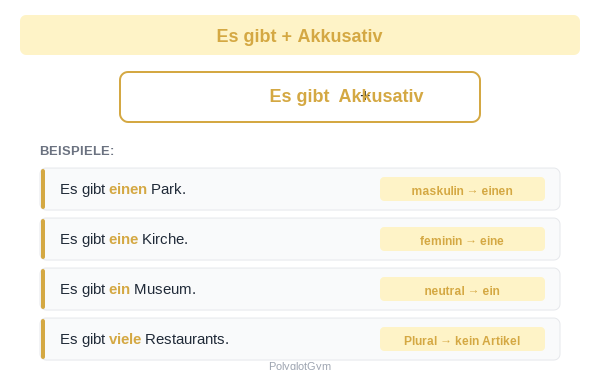
Learners use es ist instead of es gibt for existence: Es ist ein Restaurant hier instead of Es gibt hier ein Restaurant.
🇬🇧 English speakers: English speakers confuse 'es gibt' with 'es ist' since English uses 'there is' for both existence and description.
In meiner Stadt gibt es viele Parks.
In my city there are many parks.
Prepositional phrase first, then gibt es + accusative.
Gibt es hier in der Nähe eine Apotheke?
Is there a pharmacy nearby?
Asking about existence: Gibt es + location + accusative object.
Es gibt keinen Fahrstuhl in diesem Gebäude.
There is no elevator in this building.
Negation with kein in accusative: keinen Fahrstuhl (masculine).
这个主题的检测还在准备中
问问索菲
在课程中练习
在 A1 课程练习中应用此语法