句子结构A2
Nebensätze: dass, wenn, ob
Subordinate clauses with dass, wenn, and ob
学习目标
Can form complex sentences with dass, wenn, and ob
考试技能:阅读写作口语
观察以下示例,你能发现语法规律吗?
Ich hoffe, dass du bald kommst.
I hope that you come soon.
Wenn ich Zeit habe, gehe ich ins Kino.
If I have time, I go to the cinema.
Weißt du, ob der Laden offen ist?
Do you know whether the store is open?
Er sagt, dass er morgen nicht kommen kann.
He says he can't come tomorrow.
注意高亮部分,它们有什么共同点?
Subordinating conjunctions send the conjugated verb to the end. At A1 you learned weil; now three more:
| Konjunktion | Bedeutung | Verwendung |
|---|---|---|
| dass | that | Reporting thoughts, facts |
| wenn | if / when(ever) | Conditions, repeated events |
| ob | whether | Indirect yes/no questions |
Dass: Ich glaube, dass er Recht hat. Wenn: Wenn es regnet, bleibe ich zu Hause. Ob: Ich weiß nicht, ob er kommt.
Subordinate clause first: Main clause verb right after comma: Wenn es regnet, bleibe ich zu Hause.
在 A2 课程练习中应用此语法
练习题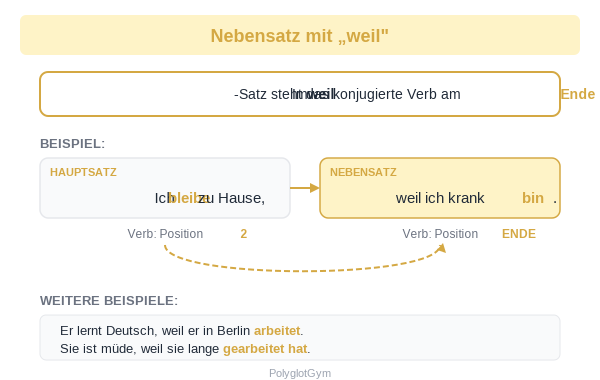
- Verb not at end: ✗ dass er hat Recht → ✓ dass er Recht hat.
- Ob for certainties: to state the fact, say Ich weiß, dass er kommt. Ich weiß, ob er kommt is grammatical, but it means "I know whether he is coming" (and I am not saying).
- Wrong main clause order: ✗ Wenn es regnet, ich bleibe → ✓ Wenn es regnet, bleibe ich.
Ich hoffe, dass du bald kommst.
I hope that you come soon.
Dass-clause: verb kommst at the end.
Wenn ich Zeit habe, gehe ich ins Kino.
If I have time, I go to the cinema.
Wenn-clause first; gehe after comma.
Weißt du, ob der Laden offen ist?
Do you know whether the store is open?
Ob for indirect yes/no question.
Er sagt, dass er morgen nicht kommen kann.
He says he can't come tomorrow.
Modal in dass-clause: kann goes to the end.
这个主题的检测还在准备中
问问索菲
在课程中练习
在 A2 课程练习中应用此语法