句子结构B1
Relativsätze (Nominativ/Akkusativ)
Relative clauses with relative pronouns in nominative and accusative
学习目标
Can define people and things using relative clauses
考试技能:阅读写作
观察以下示例,你能发现语法规律吗?
Die Frau, die neben mir sitzt, ist Ärztin.
The woman who sits next to me is a doctor.
Der Film, den wir gestern gesehen haben, war spannend.
The film we saw yesterday was exciting.
Das Kind, das im Garten spielt, ist mein Sohn.
The child playing in the garden is my son.
Die Bücher, die ich gekauft habe, sind interessant.
The books I bought are interesting.
注意高亮部分,它们有什么共同点?
Relative clauses add information about a noun. The relative pronoun matches the gender/number of the noun but takes its case from its function in the relative clause.
| Maskulin | Feminin | Neutrum | Plural | |
|---|---|---|---|---|
| Nominativ | der | die | das | die |
| Akkusativ | den | die | das | die |
Nominative: pronoun = subject: Der Mann, der dort steht, ist mein Lehrer.
Accusative: pronoun = object: Der Film, den ich gesehen habe, war gut.
Verb goes to end. Always separated by commas.
在 B1 课程练习中应用此语法
练习题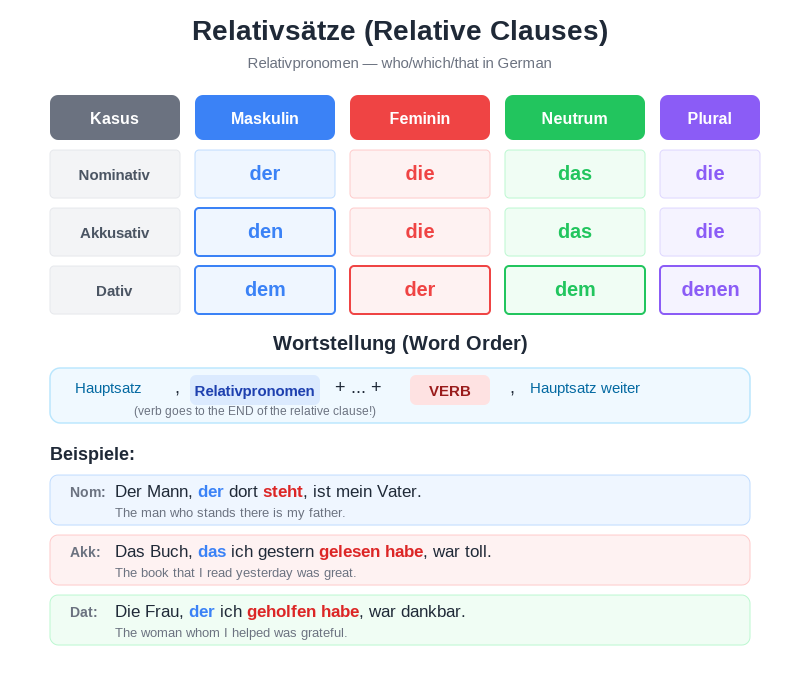
- Wrong case: ✗ Der Mann, der ich sehe → ✓ Der Mann, den ich sehe.
- Verb not at end: ✗ Die Frau, die kommt morgen → ✓ Die Frau, die morgen kommt.
- Missing comma: ✗ Das Buch das ich lese → ✓ Das Buch, das ich lese.
Die Frau, die neben mir sitzt, ist Ärztin.
The woman who sits next to me is a doctor.
Die = nominative (she sits). Frau is feminine.
Der Film, den wir gestern gesehen haben, war spannend.
The film we saw yesterday was exciting.
Den = accusative (we saw it). Film is masculine.
Das Kind, das im Garten spielt, ist mein Sohn.
The child playing in the garden is my son.
Das = nominative (it plays). Kind is neuter.
Die Bücher, die ich gekauft habe, sind interessant.
The books I bought are interesting.
Die = accusative plural (I bought them).
这个主题的检测还在准备中
问问索菲
在课程中练习
在 B1 课程练习中应用此语法