句子结构A1
Negation mit 'nicht'
Negating sentences with nicht
学习目标
Can negate statements using nicht
考试技能:写作口语
观察以下示例,你能发现语法规律吗?
Ich verstehe das nicht.
I don't understand that.
Das Wetter ist nicht schön.
The weather is not nice.
Er kommt nicht aus Berlin.
He is not from Berlin.
注意高亮部分,它们有什么共同点?
Nicht is German "not". English needs the helper "do" to negate a verb ("I don't understand"); German does not. You take the normal sentence and put nicht into it: Ich verstehe das nicht. The skill to learn is where it goes.
Where nicht goes
| What you negate | Position of nicht | Example |
|---|---|---|
| the whole sentence (the verb) | at the end, after the object | Ich kenne den Mann nicht. - I don't know the man. |
| an adjective | before the adjective | Das Bier ist nicht kalt. - The beer isn't cold. |
| an adverb | before the adverb | Er kommt nicht oft. - He doesn't come often. |
| a place or prepositional phrase | before the preposition | Er kommt nicht aus Berlin. - He isn't from Berlin. |
| a sentence with a second verb at the end | before that verb | Ich habe nicht geschlafen. / Ich kann nicht schwimmen. |
The rule of thumb
Nicht sits as late as it can in the sentence, but in front of the part it negates and in front of anything that belongs at the end of the sentence (an adjective after sein, a place, a participle, an infinitive, a separable prefix): Der Zug fährt heute nicht ab. A definite object comes before it: Ich trinke den Kaffee nicht.
Mistakes English speakers make
- Putting nicht straight after the subject, the way "not" follows "do": *Ich nicht verstehe. Correct: Ich verstehe nicht.
- Adding a "do" verb: *Ich mache nicht verstehen. German has no "do"-support.
- Using nicht with a noun that has ein or no article. "I have no car" is Ich habe kein Auto, not *Ich habe nicht ein Auto. See the topic on kein.
Contrast: nicht ... sondern
To correct something, German uses sondern (but rather) after a nicht: Wir fahren nicht nach München, sondern nach Nürnberg. - We aren't going to Munich but to Nuremberg. Here nicht moves to stand directly before the thing being corrected.
在 A1 课程练习中应用此语法
练习题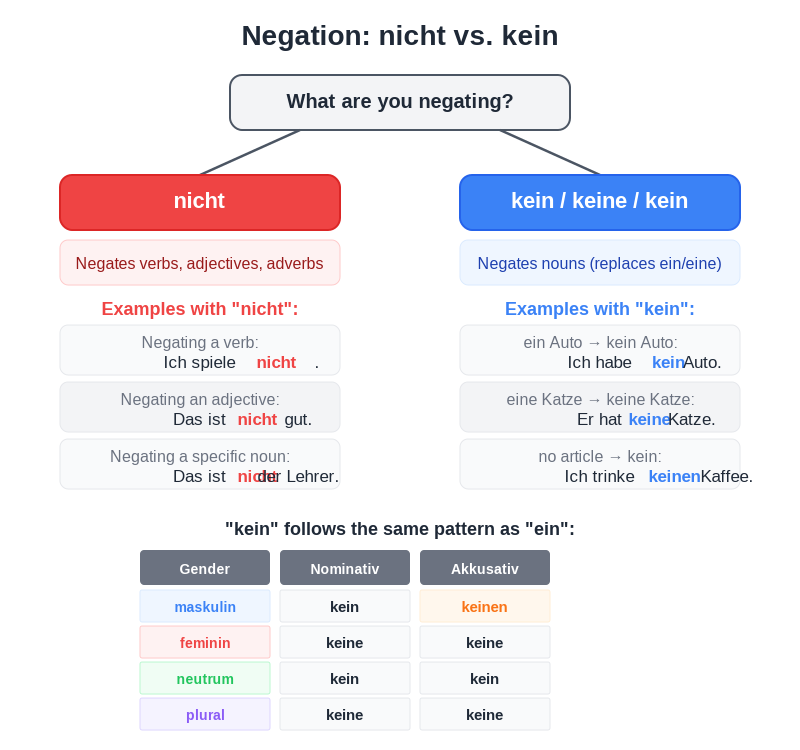
Learners put nicht in the wrong position. Rule of thumb: nicht goes as far right as possible, but before adjectives and prepositional phrases.
🇬🇧 English speakers: English speakers put 'nicht' right after the subject (like English 'not'): 'Ich nicht verstehe' instead of 'Ich verstehe das nicht'.
Ich verstehe das nicht.
I don't understand that.
Nicht goes to the end when negating the whole sentence.
Das Wetter ist nicht schön.
The weather is not nice.
Nicht comes before the adjective it negates: nicht schön.
Er kommt nicht aus Berlin.
He is not from Berlin.
Nicht comes before the prepositional phrase: nicht aus Berlin.
这个主题的检测还在准备中
问问索菲
在课程中练习
在 A1 课程练习中应用此语法