句子结构A1
Wortstellung mit Zeitangaben
Word order when time expressions come first
学习目标
Can place time expressions correctly in sentences
考试技能:阅读写作
观察以下示例,你能发现语法规律吗?
Morgen fahre ich nach Hamburg.
Tomorrow I am going to Hamburg.
Am Wochenende besuche ich meine Eltern.
On the weekend I visit my parents.
Um 8 Uhr beginnt der Unterricht.
At 8 o'clock the class begins.
注意高亮部分,它们有什么共同点?
In a German statement, the conjugated verb is the second element. Not the second word: the second building block. Usually the subject comes first, as in English. But German likes to start a sentence with something else, often a time expression, and then the subject has to move behind the verb.
| Position 1 | Position 2 (verb) | Then | Rest |
|---|---|---|---|
| Ich | gehe | heute | ins Kino. |
| Heute | gehe | ich | ins Kino. |
| Am Montag | habe | ich | Deutschkurs. |
| Um acht Uhr | beginnt | der Unterricht. |
The English pattern does not work
English keeps the subject before the verb whatever comes first: "Tomorrow I go". Copy that into German and you get *Morgen ich fahre nach Hamburg, a word-order mistake English speakers make again and again. Correct: Morgen fahre ich nach Hamburg. The time phrase takes position 1, the verb holds position 2, the subject follows.
A long phrase still counts as one position: Am ersten Sonntag im Advent backen wir mit Oma Plätzchen. Everything before backen is one block.
Not just time
The same swap happens with any first element that is not the subject: a place (In Berlin wohne ich seit drei Jahren.), an object (Deutsch lerne ich gern.), even a whole subordinate clause (Wenn es regnet, bleiben wir zu Hause.). Germans use this to put the topic or the new information where they want it.
What does not count
Und, aber, oder, denn and sondern stand outside the count: Aber heute habe ich keine Zeit. Here heute is position 1. Yes/no questions and commands are different again; there the verb comes first: Kommst du morgen? Komm morgen!
Time before place
When both time and place follow the verb, time usually comes first: Ich fahre morgen nach Köln. English tends to do it the other way round ("I'm going to Cologne tomorrow").
在 A1 课程练习中应用此语法
练习题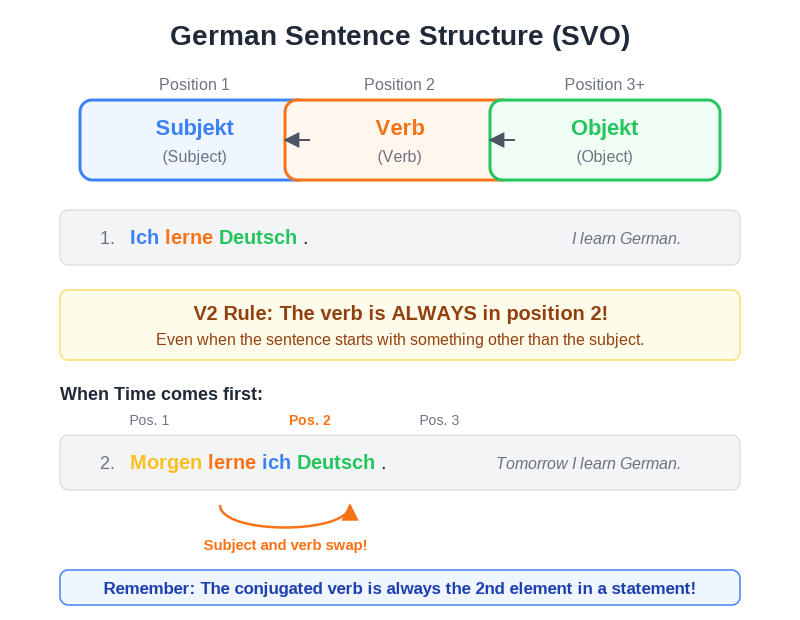
Learners keep the subject at position 1 after a time expression: Heute ich gehe instead of Heute gehe ich.
🇬🇧 English speakers: English speakers keep subject-first order after time expressions: 'Morgen ich gehe' instead of 'Morgen gehe ich' — English doesn't require inversion.
Morgen fahre ich nach Hamburg.
Tomorrow I am going to Hamburg.
Morgen at position 1, verb fahre at position 2, subject ich at position 3.
Am Wochenende besuche ich meine Eltern.
On the weekend I visit my parents.
Am Wochenende is at position 1, the verb stays at position 2.
Um 8 Uhr beginnt der Unterricht.
At 8 o'clock the class begins.
Time expression first, verb second, subject third — always.
这个主题的检测还在准备中
问问索菲
在课程中练习
在 A1 课程练习中应用此语法