句子结构A1
W-Fragen
Question words: wie, wo, woher, was, wer
学习目标
Can ask basic questions about personal information
考试技能:听力写作口语
观察以下示例,你能发现语法规律吗?
Wie heißen Sie?
What is your name? (formal)
Woher kommst du?
Where do you come from?
Was machst du beruflich?
What do you do for a living?
注意高亮部分,它们有什么共同点?
German question words are called W-Fragen because they nearly all begin with W, just as English ones begin with "wh". The trap is that several of them look like the wrong English word.
| Question word | Meaning | Example |
|---|---|---|
| wie | how | Wie heißen Sie? - What is your name? |
| wo | where (location) | Wo wohnst du? - Where do you live? |
| woher | where from | Woher kommen Sie? - Where are you from? |
| wohin | where to | Wohin fährst du? - Where are you going? |
| was | what | Was machst du? - What are you doing? |
| wer | who | Wer ist das? - Who is that? |
| wann | when | Wann kommt der Zug? - When does the train come? |
| warum | why | Warum lernst du Deutsch? - Why are you learning German? |
False friends: wer, wo, wie
Wer looks like "where" but means "who". Wo looks like "who" but means "where". Learners mix these up for months, so drill them as a pair: Wer? - a person, Wo? - a place. And wie is "how", even where English says "what": Wie heißt du? (literally "How are you called?"), Wie ist Ihre Telefonnummer?
Word order: no "do"
The question word comes first, the verb second, then the subject: Wo wohnst du? English needs a helper verb ("Where do you live?"); German simply puts the main verb in second place. *Wo du wohnst? is wrong.
Where, where from, where to
English uses one "where" for all three ideas. German splits it: Wo bist du? (where are you), Woher kommst du? (where are you from), Wohin gehst du? (where are you going). In speech the pieces often come apart: Wo kommst du her?, Wo gehst du hin?
Combinations with wie
Wie joins other words to make new questions: wie alt (how old), wie viel (how much), wie viele (how many), wie lange (how long), wie spät (what time). Wie viel kostet eine Maß auf dem Oktoberfest? - How much is a litre of beer at the Oktoberfest?
在 A1 课程练习中应用此语法
练习题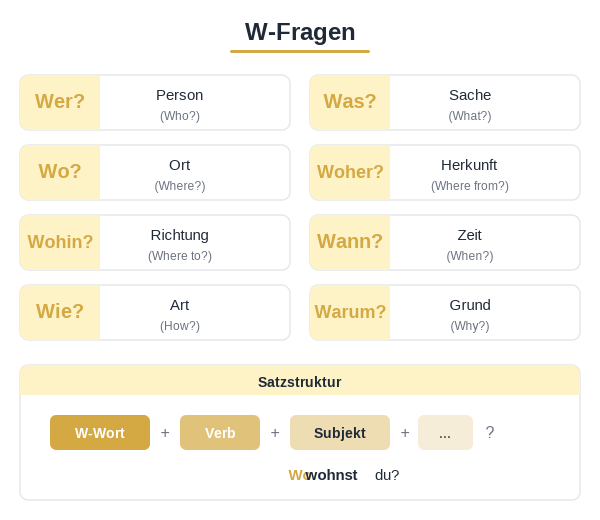
Learners confuse wo (where/location) and woher (where from/origin). Wo wohnst du? vs. Woher kommst du?
🇬🇧 English speakers: English speakers keep English SVO order after the W-word: 'Wo du wohnst?' instead of 'Wo wohnst du?' with verb at position 2.
Wie heißen Sie?
What is your name? (formal)
Wie (how) + verb at position 2 + subject.
Woher kommst du?
Where do you come from?
Woher asks about origin, not current location.
Was machst du beruflich?
What do you do for a living?
Was (what) asks about things or activities.
这个主题的检测还在准备中
问问索菲
在课程中练习
在 A1 课程练习中应用此语法