Cấu trúc câuA2
Druhá pozice příklonek
The second-position rule: clitics (jsem, bych, se, si, mi, ho) cluster after the first phrase in a fixed order
Mục tiêu học tập
I can place auxiliary and pronoun clitics in second position in the correct internal order.
Kỹ năng thi cử:CCE A2 · ViếtCCE A2 · Nói
Hãy xem các ví dụ sau. Bạn có nhận ra quy tắc ngữ pháp không?
Včera jsem se mu to snažil vysvětlit.
Yesterday I tried to explain it to him.
Líbí se mi ta písnička od Jarka Nohavici.
I like that song by Jarek Nohavica.
Půjčil bys mi ho do pondělí?
Would you lend it to me until Monday?
Chú ý các phần được đánh dấu. Chúng có điểm gì chung?
English fixes the order of the big parts of a sentence: subject, verb, object. Czech lets those move freely, but it is strict about a set of short, unstressed words called clitics (příklonky). In standard Czech they gather in a cluster in second position, right after the first phrase of the clause, in a fixed order.
Who the clitics are, and their order
| First phrase | 1 auxiliary | 2 se / si | 3 dative | 4 accusative | Rest |
|---|---|---|---|---|---|
| Včera | jsem | se | mu | to | snažil vysvětlit. |
| Půjčil | bys | mi | ho | do pondělí? | |
| Kdy | jste | si | to | koupili? | |
| Líbí | se | mi | ta písnička od Jarka Nohavici. |
- slot 1: jsem, jsi, jsme, jste and bych, bys, by, bychom, byste
- slot 2: se, si
- slot 3: short dative pronouns mi, ti, mu
- slot 4: short accusative pronouns mě, tě, ho, and to
Jsi fuses with the reflexive: Umyl ses? Koupila sis lístek?
What counts as "first"
One phrase, however long: Můj starší bratr z Olomouce se včera oženil. A subordinating conjunction counts as the first word, so the clitics follow it: Vím, že se ti to líbí. Coordinating a, ale, nebo do not count: Přišel domů a umyl se. After a fronted clause, the main clause needs its own first word: Když přijdeš, dám ti to (or …, tak ti to dám).
The English-speaker reflex
English puts the pronoun after the verb, so learners write *Včera jsem viděl ho. The pronoun belongs in the cluster: Včera jsem ho viděl. Likewise *Dal jsem to mu → Dal jsem mu to: dative before accusative, the reverse of "I gave it to him".
Another reflex is to start with the clitic: *Se mi to líbí. In standard Czech the cluster cannot open the clause, so start with the verb or another phrase: Líbí se mi to. Mně se to líbí.
What you will hear on the street
Spoken Czech bends the rule. Sem ti to říkal! (I told you so) drops the subject and starts with the auxiliary, pronounced sem; and Já byl doma leaves the auxiliary out. Both are normal colloquial Czech. In writing and careful speech use Říkal jsem ti to and Byl jsem doma.
Áp dụng ngữ pháp này vào các bài tập khóa học A2
Bài tập thực hành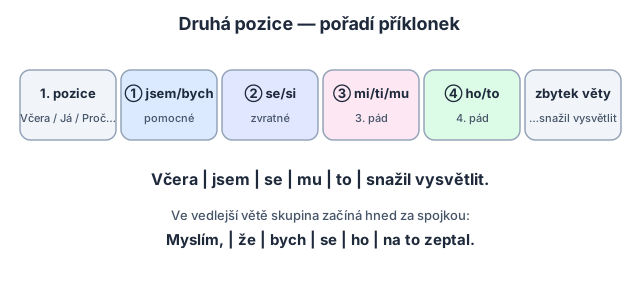
- Clitic first: *Se mi to líbí → Líbí se mi to
- Wrong internal order: *Včera se jsem umyl → Včera jsem se umyl
- Accusative before dative: *Dal ho mi → Dal mi ho
Včera jsem se mu to snažil vysvětlit.
Yesterday I tried to explain it to him.
The full cluster: jsem → se → mu → to, right after Včera.
Líbí se mi ta písnička od Jarka Nohavici.
I like that song by Jarek Nohavica.
Verb first, then se mi — the clitics cannot open the sentence.
Půjčil bys mi ho do pondělí?
Would you lend it to me until Monday?
bys → mi → ho: conditional auxiliary, dative, accusative.
Bài kiểm tra cho chủ đề này đang được chuẩn bị
Hỏi Sofi
Luyện tập trong khóa học
Áp dụng ngữ pháp này vào các bài tập khóa học A2